


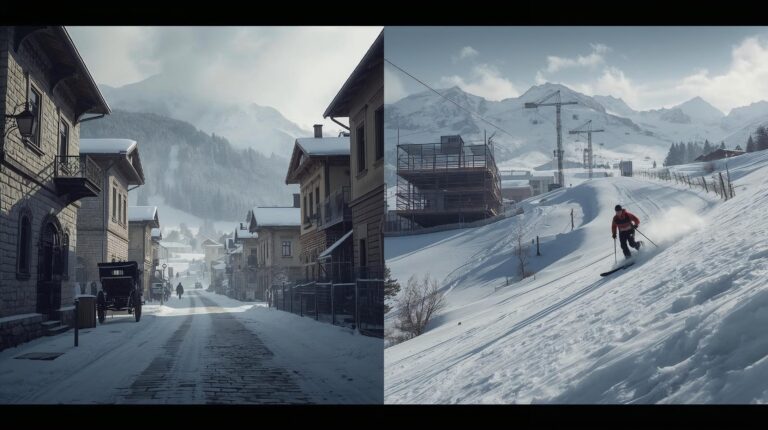
1. Introduction: The Year of the “Big Bang” for the Pirin Region
The calendar year 2003 stands out in the modern economic history of Bulgaria as a turning point for the development of mountain tourism, with this process finding its brightest manifestation in the town of Bansko. The transformation of Bansko during the period under consideration is not just a chronological segment, but a fundamental watershed, separating the era of traditional, family and largely artisanal tourism from the era of industrialized entertainment and sports infrastructure.
In economic terms, 2003 was the year in which the local market opened up to global capital, and expectations for Bulgaria's future membership in the European Union (planned for 2007) acted as a powerful catalyst for speculative and real investment interest.
This report aims to deconstruct the processes that took place in Bansko during this key year, analyzing them through several interconnected dimensions: economic dynamics and the real estate market, large-scale infrastructure construction and the associated environmental conflicts, the evolution of the tourism product, international sporting achievements and cultural life. The analysis is based on detailed empirical data reflecting both the triumph of modernization – symbolized by the launch of the new gondola lift and the visit of Alberto Tomba, and the shadows of growth – overdevelopment and the problems with the protection of the Pirin National Park.
2. Macroeconomic framework and investment climate in 2003.
2.1. National context and regional projections
In 2003, the Bulgarian economy entered a phase of accelerated growth, characterized by macroeconomic stability guaranteed by the Currency Board and increased confidence on the part of international financial institutions. This climate of security, combined with low interest rates on loans and the growth of the banking sector, created a favorable environment for directing capital to sectors with high added value, such as tourism.
In regional terms, Bansko is positioned as the main beneficiary of this trend. Unlike the Black Sea coast, where the construction boom is already in an advanced phase, the mountain resorts in 2003 were only just revealing their potential for large-scale development. Statistical data show that it was this year that the highest growth in real estate prices in the country was registered, with housing prices increasing by an average of more than 2 times in certain segments. This was the beginning of the so-called "real estate bubble", which would define the city's economy until the crisis of 2008.
2.2. The phenomenon of the real estate market in Bansko
The real estate market in Bansko was operating in a hyperactive mode in 2003. A transformation of land relations was observed, in which agricultural lands and plots on the outskirts of the city abruptly changed their purpose, becoming regulated land properties (RPL) for development.
Land and housing price dynamics
The analysis of market data for the period late 2003 - early 2004 reveals the following price levels, which illustrate the emerging segmentation of the market:
| Location / Property Type | Price range (EUR/sq m) | Value analysis |
|---|---|---|
| Central city area | ~ 100 EUR | Stability based on historical value and regulation. |
| Unregulated areas (agricultural lands) – Speculative potential | ||
| – The road to the village of Banya | 35 – 45 EUR | Area for future SPA and holiday complexes. |
| – Ring Road | ~ 40 EUR | Logistical importance. |
| – District h-l "Glazne"“ | ~ 60 EUR | Proximity to the river and existing infrastructure. |
| Zones in regulation (construction spots) – Highest interest | ||
| – District hl-l "Pirin"“ | 100 – 120 EUR | Prestigious location near the old center. |
| – The road to the ski lift | 120+ EUR | “The ”Golden Mile” of Bansko – an area with the highest potential. |
These values, although modest compared to the peak levels of 2007/2008 (when they reached 2000 EUR/sq m), represent a huge jump compared to previous years, when prices were symbolic. The growth from 24-28% for 2003 is an indicator of the inflow of speculative capital, which is outpacing the real development of the infrastructure.
Buyer structure and investment models
In 2003, a change in the investor profile was observed. If until then the market had been dominated by domestic players looking for villas for personal use, 2003 marked the massive entry of foreign investors – mainly from the UK and Ireland. The “buy-to-let” model began to establish itself as the main marketing strategy of developers. Off-plan sales became the standard, with investors financing the construction of complexes, relying on a guaranteed return on future tourist flows.
2.3. Impact of the construction sector on the local economy
Construction is becoming the leading economic sector for the municipality of Bansko, displacing traditional agriculture and small-scale handicrafts. Data from the National Statistical Institute show that construction and real estate operations generate about 18% of the total volume of foreign investments in the country, with Bansko being one of the main centers of this activity. This process leads to a rapid increase in the income of the local population through the sale of land and employment in the construction sector, but at the same time creates inflationary pressure on the prices of goods and services in the city.
3. Infrastructure development and the role of “Yulen” AD
The core of Bansko's transformation in 2003 was the large-scale modernization of the ski area carried out by the concessionaire "“Yulen” AD. This year is critical for the implementation of the investment program set out in the 2001 concession agreement.
3.1. Construction of the Gondola Lift
The most emblematic project for 2003 is the completion and commissioning of the new gondola lift of the Austrian giant Doppelmayr.
- Technical parameters and meaning: The lift is over 6 kilometers long and has a capacity of 2,000 people per hour (according to some sources up to 2,400). It connects the starting station in the city (the “Gramadeto” area) with the “Banderishka meadow”" at an altitude of 1635 meters. Before the launch of this facility, skiers were transported by a chaotic system of minibuses, which created traffic jams and pollution. The gondola solved this logistical problem and turned Bansko into a European-style resort.
- Chronology of the discovery: Although testing and partial operation began earlier (some sources indicate an opening date of November 30, 2003), the official, ceremonial opening ceremony took place on December 13, 2003.
3.2. Expansion of the ski area and accompanying infrastructure
In parallel with the gondola, other key improvements were implemented in 2003:
- New lifts: Two new 4-seater lifts (probably “Banderitsa 1” and “2”) have been installed, serving the higher parts of the mountain.
- Ski path: A 7-kilometer illuminated ski trail has been built, allowing skiers to ski back from the mountain directly to the city, connecting the ski area with the hotel area.
- Artificial snow: Massive investments are being made in artificial snow systems (“snow guns”). This is a strategic investment to guarantee the season in a changing climate, allowing the ski season to be extended by up to 5 months (December-April).
3.3. Ecological conflicts and the “Yulen” case”
The rapid development of the infrastructure in 2003 became the catalyst for a long-standing environmental and legal conflict. The ski area is located within the territory of Pirin National Park, a UNESCO World Heritage Site.
Concession violations: According to reports by environmental organizations (WWF) and investigative journalists, even in the initial stages of construction (including in 2003), the concessionaire “Yulen” AD repeatedly exceeded the permitted parameters of the concession. While the contract allows for the use of 99.55 hectares, the area actually used was subsequently found to be significantly larger (over 60% excess according to some estimates).
Institutional umbrella: Environmental organizations accuse state institutions (Ministry of Environment and Water) of passivity and toleration of violations in the name of economic growth and job creation. In 2003, logging and excavation work for new slopes and lifts were carried out, which changed the landscape of the mountain and led to the loss of World Heritage status for the affected areas, which were re-categorized as “buffer zones”.
4. Hospitality and Tourism: Changing the Architectural Paradigm
2003 marked the transition from small family hotels to large hotel complexes with a high level of categorization.
4.1. Iconic projects: Hotel “Tanne” and “Kempinski”
Hotel “Tanne”: Opened in 2003, this 4-star hotel is an example of the new wave of investment. Located at the foot of the mountain, it is built in the traditional Bansko style (stone and wood), but offers luxurious amenities such as a spa center, a Viennese salon and landscaped gardens. The hotel is a Bulgarian-German investment and set the standard for quality in the resort at that time.
The Kempinski Grand Arena project: Although the official opening was in 2005, in 2003 the project was already in an active phase of implementation and marketing. The construction of a Kempinski hotel right opposite the gondola station is a clear signal to international markets that Bansko is aiming for the luxury tourism segment. This is the first “ski-in/ski-out” hotel of this class in Bulgaria.
4.2. Architectural style and urbanization
In 2003, there was a tendency for new buildings to imitate the architectural language of the Bulgarian Renaissance – wide eaves, stone walls, wooden verandas. However, the scale of the new complexes often conflicted with the small scale of the historical center. A process of dense urbanization began in the area around the lift’s starting station, which gradually took shape as a “new city”, separated from the old center.
5. Tourism: Quantitative dimensions and visitor profile
5.1. Flow statistics
In 2003, Bansko, together with Borovets and Pamporovo, consolidated its position as a leading winter resort. The three resorts provide 40% of the bed capacity in mountain tourism and generate 72% of the revenue. The attendance during the winter season reaches over 250,000 guests, which is a huge load for a town with a population of about 10,000 people.
5.2. Structure of tourists
Foreign tourists: 2003 saw an increase in organised groups from the UK, Russia, Greece and the Scandinavian countries. The UK market in particular showed strong interest in both ski packages and property purchases.
Domestic market: Bulgarian tourists are also reorienting themselves towards Bansko, attracted by the new facilities, although price levels are starting to rise and limit access for lower-income groups.
6. Sports: Bansko on the world ski map
The 2003 sports calendar is a strategic tool for PR and legitimization of the resort before the international sports community.
6.1. Alberto Tomba's visit and the opening of the 2003/2004 season
The event of the year is undoubtedly the official opening of the ski season on December 13, 2003, with the participation of the Italian ski legend Alberto Tomba “La Bomba”.
- Chronology: Tomba landed in Sofia and was transported to Bansko, where he was given a hero's welcome. Together with Deputy Prime Minister Lidia Shouleva, he cut the ribbon on the new gondola lift and greeted the residents with "Good evening" in Bulgarian.
- Tomba Track: The culmination of the visit is the inauguration of slope No. 9, named after him – “Tomba”. This is the most difficult slope in the resort (black category), designed for experts. Tomba makes a demonstrative descent, validating the quality of the route. The slope is known for its steepness and icy sections, which makes it a challenge even for professionals.
- Social commitment: Besides the glamorous part, Tomba also visits a home for children with mental disabilities, demonstrating social responsibility.
6.2. Balkan Cup “Open” (March-April 2003)
In the spring of 2003, Bansko hosted the prestigious Balkan Cup alpine skiing competition. This event was a test of the organizational abilities of “Yulen” and the Bulgarian Ski Federation (BFSki).
Results and standings
| Discipline | Winner / Participant | Time / Result | Notes |
|---|---|---|---|
| Slalom (Men) | |||
| 1st place | Vasilis Dimitriadis (Greece) | 1:31.20 min | The Greek ace wins a hard-fought battle. |
| 2nd place | Drago Grubelnik (Slovenia) | +1.62 sec | Famous World Cup competitor. |
| 3rd place | Stefan Georgiev (Bulgaria) | +1.93 sec | The best Bulgarian alpine skier (SC “Yulen”) climbs the podium. |
| Slalom (Women) | |||
| 1st place | Jelena Jolovic (Serbia) | – | Dominates the competition. |
| 2nd place | Akhmeteli (Georgia) | +2.48 sec | – |
| 3rd place | Maria Kirkova (Bulgaria) | +3.30 sec | The future star of Bulgarian skiing. |
Competition analysis: Despite the bad weather conditions, the organization was highly appreciated. The participation of strong teams from Slovenia and the Czech Republic (including Stanley Heyer) raised the rank of the competition. Drago Grubelnik (Slovenia) fell in the second run of the second slalom, which opened the way for a victory for Dimitriadis and a podium for Georgiev.
7. Culture: Jazz, Traditions and Modernity
The cultural life of Bansko in 2003 was a unique synthesis between the deep folklore roots and the imported "high" culture represented by the jazz festival.
7.1. Sixth International Jazz Festival (August 2003)
Held from August 8 to 13, 2003, the festival under the patronage of Dr. Emil Iliev established itself as the most significant summer music event.
Notable participants and performances:
- Kamelia Todorova: She celebrates 25 years on stage with a concert presenting the album “Pleasure.” Her presence is a symbol of continuity in Bulgarian jazz.
- Theodosius Spasov Quartet: It presents a unique ethno-jazz fusion, mixing kaval with modern rhythms.
- Yildiz Ibrahimova: The world-famous singer with a four-octave range participated in a collaboration with the Turkish Army Orchestra, demonstrating the power of musical diplomacy.
- NATO Orchestra (SHAPE Big Band): The presence of this orchestra is significant in the context of Bulgarian foreign policy and the aspiration for NATO membership (achieved in 2004).
- Milcho Leviev and Vicky Almazidou: The legendary pianist, who worked in the USA, returns to his home stage, bringing world-class talent.
Social effect: The festival is free to the public, takes place at Nikola Vaptsarov Square and creates a unique atmosphere of "jam sessions" until the morning, democratizing jazz and making it accessible to locals and tourists.
7.2. Traditional cultural calendar
Outside of jazz, Bansko keeps its traditions alive:
May holidays: Holding Canadian wrestling tournaments and the Tanne Cup football tournament.
Folklore: The taverns function as living museums of Bansko song. Groups such as “Banski Starcheta” continue to be carriers of the unique two-part singing, which is part of the intangible heritage of the region.
8. Conclusion
2003 was the “year of acceleration” for Bansko. It laid the foundations for the modern appearance of the town, characterized by:
- Tourism Industrialization: Transition from small-scale to mass tourism through technological innovation (gondola).
- Economic expansion: Start of the property boom and attraction of foreign capital, which changed the social stratification in the city.
- Branding: Successful positioning on the international stage through names like Alberto Tomba and events like the Jazz Festival.
- Ecological price: Setting the beginning of the long-term conflict between investment interests and nature conservation in Pirin National Park.
Historically, 2003 can be seen as the year in which Bansko made its irreversible choice – to be not just a museum town, but a dynamic, albeit controversial, European resort.
Application: Statistical Data
Table 1: Comparative analysis of ski infrastructure (2002 vs 2003/2004)
| Component | Status until 2002. | Condition season 2003/2004 | Effect |
|---|---|---|---|
| Transportation to the area | Minibuses, personal cars | Gondola (Doppelmayr), 8-seater, 6 km long | Elimination of traffic jams, eco-effect (partial). |
| Transport capacity | Highly restricted, chaotic | 2000 – 2400 people/hour | A sharp increase in permeability. |
| Elevators (High Zone) | Old 3-seaters and tow trucks | 2 new 4-seater lifts | Comfort and speed. |
| Tracks | Standard, snow dependent | New Tomba track, expansions, artificial snow | Extending the season, attracting experts. |
| Connectivity | No connection to skiing | Ski path (7 km) to the city | “Ski-in” option. |
Table 2: Real estate price levels (End of 2003)
| Category | Location | Price (EUR/sq m) | Trend |
|---|---|---|---|
| Agricultural land | Road to Banya | 35 – 45 | Bullish (speculative) |
| Agricultural land | Ring Road | ~ 40 | Ascending |
| Plots in regulation | Glazne area“ | ~ 60 | Stable growth |
| Plots in regulation | Zone "Gondola" / h-l "Pirin"“ | 100 – 120 | Exponential growth |
| Apartments | New construction (greenfield) | 100 – 400 | Home of the bubble |
 English (UK)