


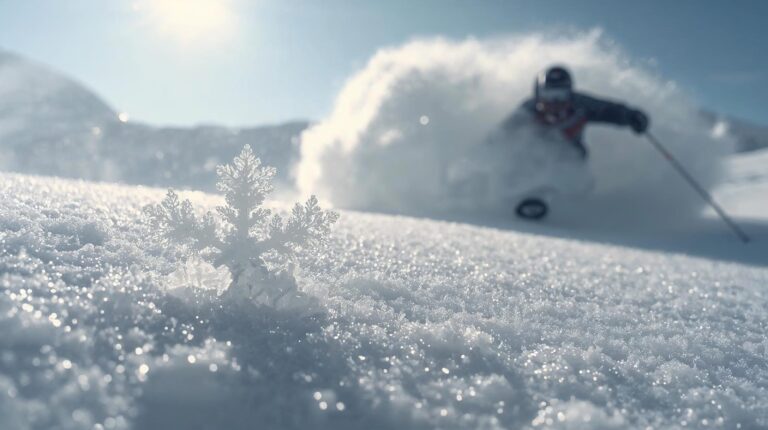
When we look out the window and see a white blanket, we simply say to ourselves, „It’s snowing.“ But for the skier, the mountaineer, and the explorer, knowing the different types of snow is a matter of pleasure and safety. Snow is never just „snow“. It is a living organism that changes every minute. It has a memory, it has a voice and it hides unsuspected secrets that we will reveal in the following lines.
1. How a snowflake is born (It's not frozen rain!)
Many people confuse snow with freezing rain. The difference is huge, and the physics behind the process determine what types of snow will cover the slopes.
- Freezing rain (hail/sleet) is a water drop that freezes as it falls. It's just a ball of ice.
- The snowflake is born through a process called deposition. Water vapor in clouds passes directly into a solid state (ice) without becoming water.
Curious: The shape of a snowflake depends on the temperature at which it formed:
- At -2°C plaques are formed.
- At -15°C (the golden mean for skiers) those beautiful, branched stars (dendrites) are formed, which hold a lot of air and create the much-loved “powder”.
2. Snow as a recording studio
Have you ever noticed how quiet it gets outside when fresh snow falls? It's not an illusion. Fresh, fluffy snow is made up of up to 90-95% air. The space between the snowflakes acts as a perfect acoustic foam that absorbs sound waves.
Helpful tip: Listen to the snow under your shoes!
- If it squeaks loudly ("crunch-crunch"), the temperature is below -10°C. The crystals are hard and break under your weight.
- If it is quiet and makes a "clap-clap", the temperature is about 0°C. The snow is wet and the crystals slide over each other instead of breaking.
3. The Dictionary of the Mountain: Basic Types of Snow
The mountain offers many faces, each requiring a different technique. Here is a detailed breakdown of the types of snow according to the skier's perception:
| Type Snow | Description | Riding feel |
|---|---|---|
| Powder | The holy grail. Fresh, light and dry snow. | Levitating or cloud surfing. |
| Velvet (Corduroy) | A groomed track in the morning (“corduroy”). | Perfect grip and fast carving turns. |
| Plowed snow (Crud) | Powder that hundreds of people have walked through. | It requires a lot of strength and active footwork. |
| Ice | Melted and refrozen solid layer. | Hard and noisy. Requires very well sharpened edges. |
| Slush | Spring, heavy and wet snow. | It slows down the skiing ("mashed potatoes"), puts strain on the knees. |
The exotic shapes of snow
In addition to the classics, nature also creates unique phenomena that you can encounter in the high parts of Pirin:
- Firn: „"Old snow" that has been there for at least one summer. The transition to glacial ice. A favorite of climbers for its stability.
- Sastrugi: Ripples on the surface, sculpted by the wind, hard as stone.
- Watermelon Snow: Pink snow with a faint watermelon scent caused by the bloom of specific algae (Chlamydomonas nivalis). It is beautiful, but don't eat it – acts as a strong laxative!
4. The Deadly “Sandwich”: How to Read Danger
The most important skill for any freerider is to understand the structure of the snowpack. Think of the different types of snow as a cake with slush. It snows, the sun shines (makes a crust), it snows again, the wind blows.
- The danger: When you have a heavy, dense layer of snow (snowboard) lying on top of a layer of light, crumbly sugar crystals (called deep frost).
- It's like putting a concrete slab on top of glass marbles. All it takes is a skier to walk over it to upset the balance and the "slab" starts to slide down. This is the mechanism of the “snowboard” avalanche”.
5. The truth about color
Snow is not actually white. Snowflakes are made of ice, and ice is transparent. We see it white because the many facets of the crystals reflect the entire spectrum of visible light. If the ice is very thick and deep (as in glaciers), it absorbs the red spectrum and reflects only the blue - which is why glaciers appear turquoise blue.
6. When magic shows its dark side (Survival)
The beauty of the „powder“ comes at a price. When you leave the marked piste, you enter a territory where snow is no longer a decoration, but an element. To stand a chance against it, you must carry the so-called “Holy Trinity”. These are not just accessories, but the only tools that work when the laws of physics turn against you.
Mandatory equipment (“The Holy Trinity”)
1. The Invisible Connection (Avalanche Device / “Pips“")
Under tons of snow, you are invisible and inaudible. This device is your only „voice,“ broadcasting a signal through the dense snow mass.
Important: It is always worn under the jacket, attached to the body, not in the backpack, which can be torn off.
2. The extended arm (Avalanche probe)
Even if the device shows you where you are, it's impossible for your friends to dig blindly. The probe is a long rod that they literally "feel" the snow with to find the difference between the density of the snowdrifts and the softness of the body.
3. The Battle with Concrete (Avalanche shovel)
Here we return to physics. The moment the avalanche stops, friction generates heat, followed by instant freezing. The snow turns to concrete in seconds. Plastic shovels break immediately - only a metal one can penetrate this mass.
Bonus (Airbag backpack): It uses the principle of “reverse segregation.„ By inflating the airbags, you become “bigger” and physics helps you float to the surface of the avalanche.
 English (UK)