

1. What is a D Visa and why is it critically important?
The biggest misconception among newcomers is that they can arrive in Bulgaria as tourists (with a visa-free regime or a tourist visa C) and while they are here, apply for long-term residency. This is absolutely impossible according to Bulgarian law.
To live legally in Bansko as a third-country national, your first step mandatory starts in your home country or the country where you are legally resident. You must apply for Long-term residence visa (D visa) at the nearest Bulgarian embassy or consulate.
⚠️ Attention: Important rules for Visa D
A type „D“ visa is usually valid for 6 months (180 days). Its sole purpose is to allow you to enter Bulgaria and give you time to submit your documents for a residence permit to the Migration Directorate. It is not a permanent status!
2. Popular reasons for obtaining a D Visa and residence
The Bulgarian state requires you to have a solid legal basis to settle here. For the expat community in Bansko, the most common and successful paths are the following:
Commercial representation of a foreign company (TR)
This is perhaps the most popular method for entrepreneurs and digital nomads from third countries. If you own or work for a company outside of Bulgaria, you can register its Commercial Representative Office with the Bulgarian Chamber of Commerce and Industry (BCCI). The representatives (up to 3 people) are entitled to a D Visa and subsequent residence. It is important to know that the representative office is not allowed to conduct business in Bulgaria – it is only for marketing and contacts.
Financially independent retirees
Bulgaria is extremely hospitable to retirees. If you receive a pension in your home country (whether you are 55 or 75 years old) and can prove that you have sufficient funds to support yourself in Bulgaria (usually requiring a bank account with available funds equal to at least 12 minimum Bulgarian pensions), you will easily obtain a visa and residence.
Investments and Real Estate
Although buying an apartment in Bansko for 50,000 euros is a great investment, it is not in itself It does NOT give you the right of residence (only gives you the right to a multiple-entry tourist visa). To obtain a residence based on property, the law requires an investment of at least 600,000 leva (about 306,000 euros). Therefore, most owners of small properties use the grounds of "Commercial Representation" or "Pensioner".
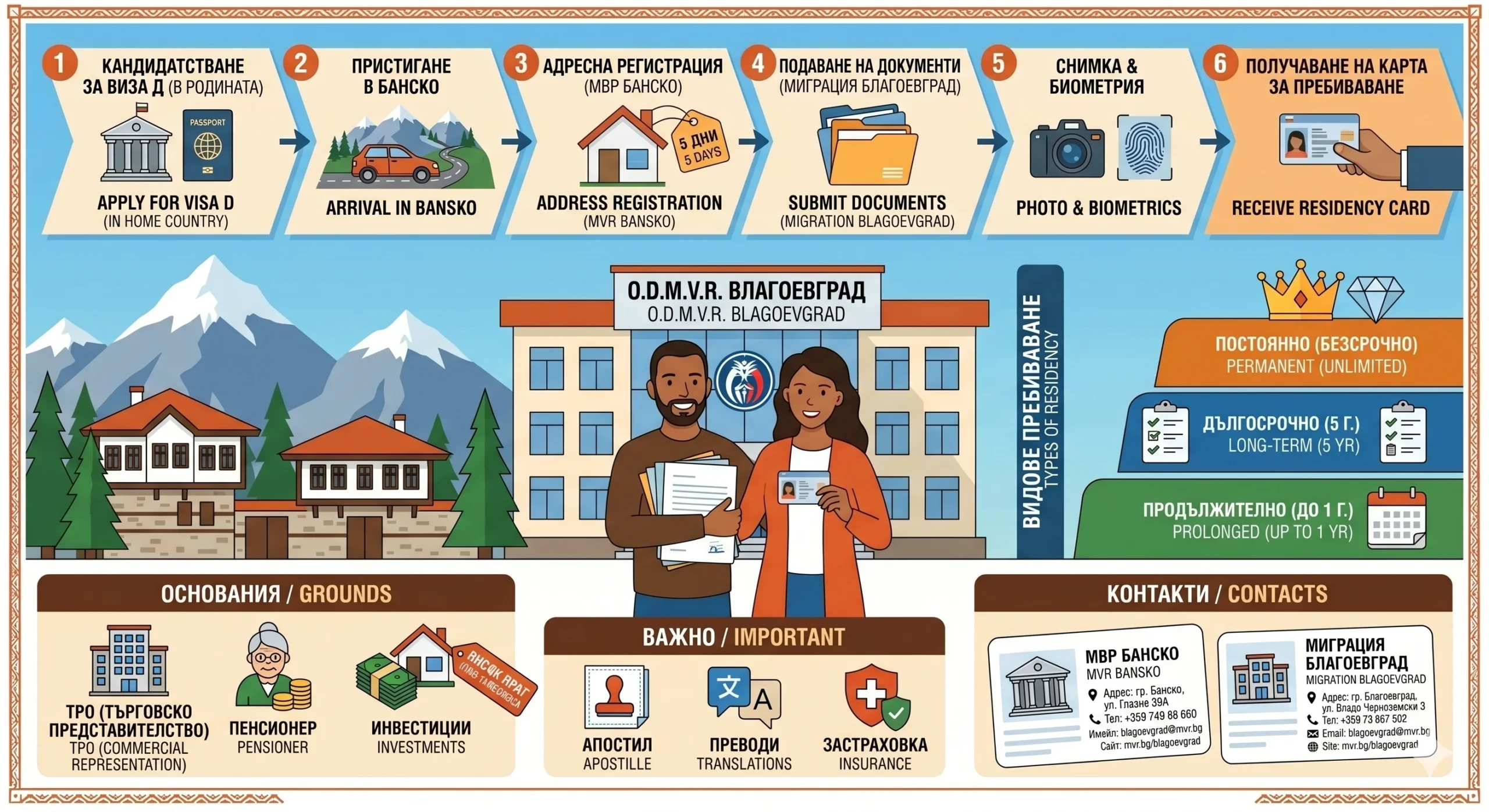
Infographic showing the 6 steps to obtaining a Bulgarian ID card for foreigners in Blagoevgrad and Bansko, types of residence, grounds for application, important documents and contacts for the Migration Directorate and the Ministry of Interior.
3. The procedure at the Migration Directorate – Blagoevgrad
Once you have successfully received your Visa D in your passport, you arrive in Bansko. Here is the exact sequence of actions:
- Address registration (up to 5 days): Upon arrival, you must go to the local Ministry of Interior Office in Bansko (39A Glazne Street) with your rental agreement or notarial deed to declare where you will live.
- Submission of documents (at least 14 days before visa expiration): You must visit the Migration Department at the Regional Directorate of the Ministry of Interior in Blagoevgrad. There you submit the full set of documents proving your grounds (the same ones you used for the visa, but translated and legalized for Bulgaria), plus medical insurance and proof of financial means.
- Approval: The review process takes up to 14 days.
- Photo and fingerprints: After approval, you pay the state fee and return to Blagoevgrad for biometric data.
- Getting the card: Your Bulgarian identity card for a foreigner is issued.
4. Residence Permits: Temporary vs. Permanent
The Migration Directorate issues different types of status to non-EU citizens. It is crucial that you understand the difference between them.
Temporary (Long-term) residence
This is the first status that everyone receives. It is also called “long-term residence”. It is issued for a period of up to 1 year. This means that every year, approximately a month before your card expires, you must repeat the procedure in Blagoevgrad, proving that your reason (e.g. pension or commercial representation) is still valid.
Long-term and Permanent Residence
After you have renewed your temporary residence for a period of 5 consecutive years (without interruption and subject to compliance with the requirements for stay in the country), you acquire the right to apply for a higher status.
- Long-term stay: It is initially issued for a period of 5 years. This status is strongly tied to European directives and gives you broad rights on the labor market.
- Permanent residence: This is the ultimate status before citizenship. It gives you the indefinite right to live in Bulgaria. The plastic card itself is renewable (as are Bulgarian ID cards), but your status itself does not expire.
5. Common mistakes made by expats in Bansko
To save you headaches and money, here are the most common traps that third-country nationals fall into:
- Translations and legalization: Your documents (e.g. marriage certificate, criminal record certificate from the US or UK) must have an Apostille stamp from the issuing country. Without an Apostille, Bulgarian authorities will not recognize them, even if they are perfectly translated into Bulgarian.
- Missing deadlines: If your Visa D or annual pass expires even by 1 day, you are in violation. The fines are steep, and the procedure is reset – you may have to return to your home country and apply for a Visa D from the very beginning!
- Bank accounts: Opening an account for third-country nationals in a Bulgarian bank has recently been associated with heavy compliance checks. Start this process months in advance.
Establishing a non-EU residency in Bansko requires patience, accuracy and excellent documentation organization. Although the bureaucracy may seem complicated, life at the foot of the Pirin Mountains is definitely worth the effort.
Do you need assistance with Visa D or the Migration Directorate?