

💡 Useful tip for tourists
Most museums in Bansko operate with a single combined ticket that gives you access to all the main sites in the city at a preferential price. This is the most affordable way to explore the city's cultural heritage.
1. The Spirit of the Renaissance: House Museums and Ethnography
A walk through the cobblestone streets of the old town is like a journey back in time. the weather. Here, every house has its own history, and the architecture is unique for the country – the so-called "Banska fortified house".
Nikola Vaptsarov House Museum“
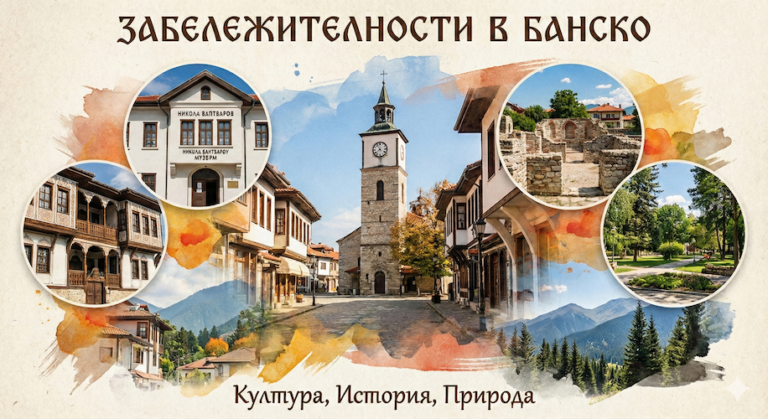
In the center of the city, on the emblematic square, is the birthplace of one of the greatest Bulgarian poets – Nikola Vaptsarov. The museum is not just a building, but an emotional experience. Through modern multimedia means, visitors can experience the life, work and anti-fascist activities of the poet. This is one of the first museums in Bulgaria to introduce innovative methods of exposition.
Velyanova house
If you have to visit only one old house in Bansko, let it be Velyanova. It is an architectural masterpiece from the Bulgarian Renaissance era. Declared a cultural monument of national importance, it impresses not only with its fortified structure (hideouts and loopholes), but above all with its unique interior decoration. The frescoes and woodcarvings are the work of master Velyan Ognev - a representative of the Debar Art School, who turned his home into a work of art.
House-Museum “Neofit Rilski”
The birthplace of the patriarch of the new Bulgarian education – Neofit Rilski (Nikola Poppetrov Benin), is another must-see site. The house is a typical representative of Bansko architecture from the 18th century and has been preserved in its authentic form. Here you can see the monastery school and learn more about the man who created the first Bulgarian grammar and translated the New Testament.
Radonova House (Historical and Ethnographic Complex)
This museum offers the most complete picture of the history of the region. The exposition traces the development of Bansko from ancient times (Thracian period) to the beginning of the 20th century. Here are exhibited archaeological finds, ethnographic materials, costumes and household items that tell how the people of Bansko lived through the centuries.
⚠ Attention: Working hours
Museums in Bansko usually have a lunch break between 12:00 and 13:00 (or 13:00 – 14:00). Check the current opening hours before visiting, especially on weekends and holidays.
2. Faith and Art: Churches and Spirituality
The Bansko art school is a phenomenon in Bulgarian art, and the local temples are the living galleries of its masters.
Holy Trinity Church“
The symbol of Bansko, visible from almost every point of the town and the mountain. Built in 1835 with enormous efforts and diplomacy by the local population during the Ottoman rule, it was the largest church in the Balkans before the construction of “St. Alexander Nevsky”. The tower with the bell tower and clock was added later and is the emblem of the town. The interior is impressive, with an iconostasis and frescoes by Velyan Ognev and Dimitar Molerov.
Church of the Assumption of the Virgin Mary“
Разположена в гробищния парк, тази църква е по-стара от “Света Троица” и носи особена мистика. Построена върху основите на средновековен храм, тя е известна с изящния си дърворезбован иконостас – един от най-ценните в България. Легендите разказват за чудотворни икони и скрити истории, които местните пазят ревниво.
Permanent iconic exhibition
The building of the former convent, near the monument to Paisii Hilendarski, houses an exceptional collection of icons. This is the place where you can appreciate the true craftsmanship of the Bansko Art School. The exhibition includes original works by Toma Vishanov, Dimitar and Simeon Molerov - artists who changed the canons of icon painting.
Spiritual and Historical Center “St. Paisius of Hilendar”
Built on the site of the birthplace of Paisii Hilendarski, this center is a modern memorial to the author of “Slavonic-Bulgarian History.” The main attraction here is the exact reconstruction of his cell from the Hilendarski Monastery, as well as the chapel “St. Ivan Rilski”.
3. Walk and Relax in the City
After the historical tour, the city also offers places for recreation that combine modern comfort with nature.
City park
The green heart of Bansko. The park has been completely renovated and offers great conditions for walking with children, jogging or just relaxing on a bench among the pine trees. Here is also the artificial lake with the island, which is a favorite place for photos.
The Sunday market
To really get a feel for the city, visit the traditional market on Sundays. Local producers from all over the region sell their wares, from homemade cheese and honey to seasonal fruits, vegetables and handicrafts. It’s the best place to buy authentic souvenirs and food.
4. Ancient History and Archaeology (The Surroundings)
For adventure and trekking lovers, the surroundings of Bansko hide secrets buried for millennia.
Archaeological Complex "St. Nicholas"“
Located in the area of “St. Nikola”, about 4-5 km from the city, this complex was discovered relatively recently. Excavations revealed the remains of a Thracian sanctuary and an early Christian basilica. The place is landscaped, and the view of the Razlog Valley and the three mountains (Pirin, Rila and Rhodope) is breathtaking.
Late Antique Fortress “Sitan Kale”
Deep in the foothills of Pirin, along the Glazne River, lie the remains of the Sitan Kale fortress. It is believed to have played a key role in the defense of the region during late antiquity and the Middle Ages. It is reached by a marked eco-trail, making a visit a great opportunity for a gentle mountain hike.
“Staroto Gradishte” Fortress and “Shipotsko” Area”
These sites complete the archaeological map of Bansko. In the area of “Shipotsko” foundations of early Christian basilicas and ceramics have been discovered, testifying to a bustling life centuries ago. The walk there is pleasant and does not require special preparation.
 English (UK)