
In this comprehensive guide, we will take you through the quiet courtyards of the city's temples and outline routes to the largest spiritual centers in Bulgaria, located a short distance from the city.
Symbols of Faith: Churches in Bansko
The walk through the spiritual monuments of the city begins in its very center. These sites are part of the One Hundred National Tourist Sites and tell the story of the Bansko Art School.
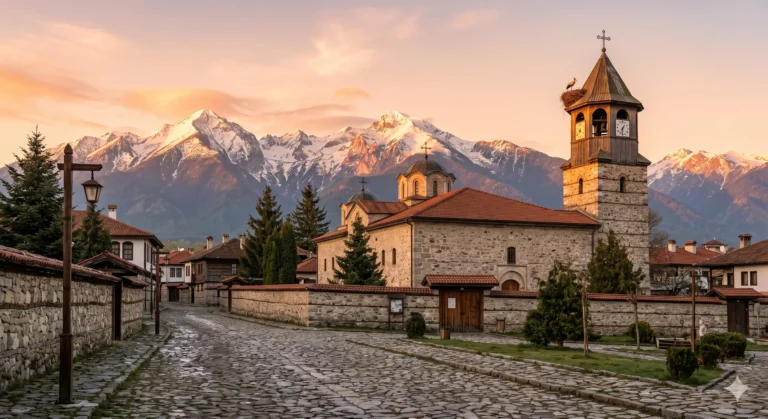
1. Holy Trinity Church – The Architectural Masterpiece
It is not just a temple, but a declaration of independence. Completed in 1835, Holy Trinity was the largest church in Bulgaria until the construction of Alexander Nevsky in Sofia.
- History of diplomacy: The Banska Bystrica residents were extremely cunning. To obtain a building permit from the Ottoman authorities, they buried an icon in the ground at the site, claiming that they were restoring an old Christian temple. In addition, a Christian cross and an Islamic crescent were carved side by side above the entrance – a gesture of tolerance that saved the building from destruction.
- Interior: The frescoes are the work of Dimitar Molerov, and the carved iconostasis is a supreme achievement of woodcarving. Pay attention to the ceiling – it is painted as a night sky, dotted with golden stars, a symbol of the divine presence.
- The bell tower: Built later (1850) by Usta Gligor Doyuv, it rises 30 meters and to this day measures the time in the heart of the city.
2. The Church of the Assumption of the Virgin Mary„
Located near the center, it is the older „sister“ of the „Holy Trinity“. Built in the mid-18th century, it bears the typical features of temples of that time – slightly dug into the ground and outwardly unpretentious, so as not to annoy the enslavers.
The real treasure here is the iconostasis. It is considered one of the finest examples of the Bansko School, distinguished by the exceptional detail of the plant and animal motifs. Here the silence is almost physically palpable.
3. Archaeological Complex "St. Nicholas"„
About 4 km east of Bansko is the area of "St. Nikola". Research here has revealed an early Christian basilica from the 4th-5th century, which proves that Christianity in the region has millennial roots. Today the place has been restored, and from its height a stunning view of Pirin, Rila and the Rhodope Mountains opens.
💡 Expert advice for tourists:
If you visit Holy Trinity during a Sunday service, you will have the opportunity to hear the unique male chant that echoes through the high vaults. Please observe etiquette and do not use flashbulbs inside the church.
Day Trips: The Great Monasteries Around Bansko
Bansko is the perfect starting point for visiting the two largest spiritual centers in Southwestern Bulgaria – the Rila and Rozhen monasteries.
Rila Monastery – Fortress of the Spirit
The distance from Bansko is about 95 km (about 90 minutes by car). Founded in the early 10th century by the hermit St. Ivan Rilski, the monastery is a UNESCO site and a symbol of Bulgarian statehood.
What not to miss:
- Raphael's Cross: The monastery museum houses this unimaginable creation – a wooden cross on which the monk Raphael carved over 650 miniature figures. The work took him 12 years and cost him his eyesight.
- Hrelja Tower: The medieval defensive tower from 1335, which is the only fully preserved building from that time.
- The Saint's Cave: 4 km from the monastery is the cave where St. Ivan Rilski spent years in prayer. Tradition dictates that you pass through the narrow gap in the rocks to cleanse your sins.
Rozhen Monastery – Peace in the Sands
100 km south of Bansko, at the foot of the Melnik Pyramids, is the Rozhen Monastery. It is a place for people seeking peace. The monastery is famous for its miraculous icon of the Holy Virgin Vratarnitsa.
After visiting the monastery, be sure to take a walk to Melnik (only 5 km away), where you can try the famous Melnik cheese. mulled wine and live music in one of the old house museums.
The Mystery of the Village of Dobarsko
Just 20 km from Bansko lies one of the most mysterious places in Bulgaria – the church of St. Theodore Tyrone and Theodore Stratilates in the village of Dobarsko. Small and buried in the ground, it hides frescoes from 1614 that amaze scientists.
The most famous mural is that of the "Transfiguration", where, according to many, Jesus Christ is depicted in an object resembling a space rocket. Whether this is an artistic technique or an ancient message - judge for yourself during your visit.
Comparison table of spiritual objects
| Venue | Distance from Bansko | Visiting time | Entrance fees |
|---|---|---|---|
| Holy Trinity Church„ | 0 km (Center) | 45 – 60 min. | Free (museum is paid) |
| Rila Monastery | 95 km | 3 – 5 hours | Free (museum: 8-10 BGN) |
| Church in Dobarsko | 20 km | 1 hour | About 6-8 BGN. |
Practical information for 2026
If you are planning a tour of the churches and monasteries in Bansko, keep in mind the following details:
- Clothing: Monasteries are open. Shorts and T-shirts are not allowed. Wear a scarf or outerwear.
- Transportation: The road to the Rila Monastery through Predel is in excellent condition, but be careful of ice in winter.
- Parking: In Bansko, use the "Blue Zone" or the parking lots of the big hotels. At the monasteries, parking usually costs between 5 and 10 leva per day.
- Useful link: Check the official tourist portal of Bansko for current museum opening hours.
Conclusion
Visiting these holy places is not just sightseeing. It is a way to get to know the roots of Bulgarian faith and art. Whether you choose the majestic „Holy Trinity“ or the mystical church in Dobarsko, you will return from your trip richer – spiritually and culturally.