

Etymology and hidden meaning of Božić in Bansko
The word "Božić" has an ancient Slavic root and carries an extremely strong emotional charge. Morphologically, it is composed of the root "Bog" and the diminutive suffix "-ić" (similar to "junačić" or "kralevich"). The literal translation is „"Little God"“ or „"Son of God"“.
While the popular name Christmas (derived from the Latin calendar) marks the purely calendar beginning of the new year, Christmas in Bansko personifies the holiday itself. For the old Bulgarians, this was not just a date, but a Person. In folk beliefs, Bozhic is the newborn Sun itself.
On the longest night of the year, around the winter solstice, our ancestors believed that the sky opens and the boundaries between the worlds disappear. The old sun has exhausted its strength. The world is facing the threat of eternal darkness. It is then, in the womb of the darkest night, that the „Young God“ is born. He is the little sun that from the next day begins to grow „like a millet grain“ to bring hope and life back to the earth.
The Great Battle in the Hearth: The Yule Ritual
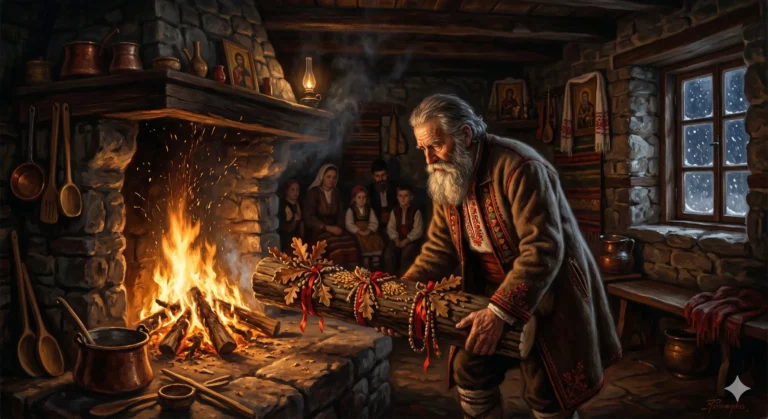
In the Bansko region and the entire Pirin region, the central event of the holiday is not the commercial exchange of gifts, but the spiritual drama that takes place in the home. This is the sacred ritual of the Yule log, which symbolizes the change of the heavenly masters.
The felling of the sacred tree
Preparation for Christmas in Bansko begins in the early hours of Christmas Eve. The owner of the house, necessarily dressed in festive new clothes, goes to the forest. The choice of tree is critical - it must be healthy, prolific and "clean" (usually a holm oak or a pear).
The process of felling is accompanied by strict rules: the tree must not touch the ground, so as not to be „stained“ with mortality and so that its power does not leak into the soil. It is carried on the right shoulder to the very threshold of the house. When the owner enters, he greets the family with the sacred question:
„"Do you praise the Young God?"“
And the family answers in chorus: „"We celebrate, we celebrate, you are welcome!"“
| Ritual element | Action in the Pirin region | Symbolism |
|---|---|---|
| Smelling | Drilling a hole and pouring olive oil, mulled wine and live music and incense. | Consecration of the tree as a living sacrifice. |
| Burning | The Christmas tree should burn brightly all night long. | The death of the old year and the birth of the new energy. |
| The ashes | It is not thrown away; it is scattered in the fields or used as medicine. | A magical substance for fertility and health. |
The Table for Young God: The Christmas Tree as an Icon
On Christmas Eve (which the locals call "Little Christmas"), the table is loaded with prayerful meaning. At its center is the ritual bread, known in Bansko as „"Goddess"“ or „"Christmas tree"“.
This bread is not just food. Since in the past icons were a rarity and a luxury for the ordinary peasant, the bread served as a "temporary icon". On it, the entire microcosm of Banska Bystrica is sculpted from dough:
- The pen – for livestock health;
- The plow and the field – for a rich harvest;
- The Cross – for God's blessing on the home.
The table in Bansko is traditionally laid out on straw on the ground. This is not a random choice. The straw symbolizes both the manger in which Jesus was born and Mother Earth herself, who must be fertilized by the light of heaven in order to bear wheat in the summer.
Did you know that?
In Bansko, the oldest man incenses the table not just with a censer, but often uses the plowshare from the plow. This is a unique symbiosis between Christian purification with incense and the deep reverence for agricultural labor that sustains life.
The Christmas Carolers: The Spiritual Army of Christmas
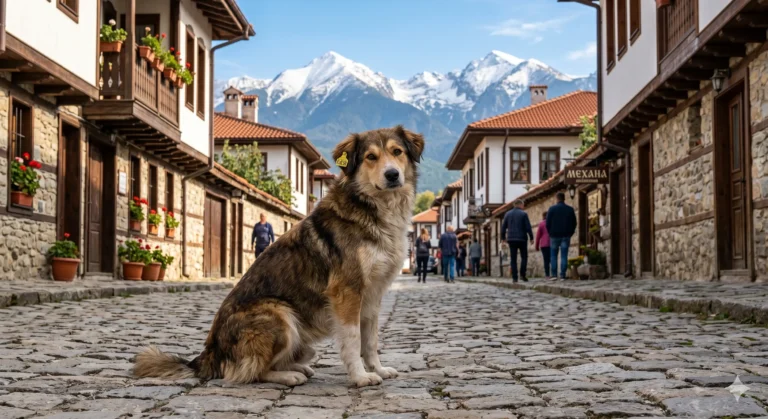
As the night progresses and the Christmas tree begins to sparkle, heavy footsteps can be heard on the cobblestone streets of Bansko. These are the carol singers. In southwestern Bulgaria, their songs are among the most archaic in the Balkans, preserving fragments of pre-Christian hymns.
Unlike modern notions of entertainment, in the past, caroling was critically important male rite. It was believed that on Christmas Eve the world was in chaos and "unclean forces" (karakonjuli) roamed outside. The carolers were the spiritual "army" who, through the power of words and rhythm, "reordered" the universe.
In their songs, Božić is often described as a powerful Hero on a golden horse or as a bright Sun shining on the forehead of the Virgin Mary. The refrain „"It's knocking, it's knocking Young God"“ is a magic spell for new beginnings.
How to experience Christmas in Bansko today?
Today, Bansko combines modern ski tourism with a jealously guarded ancestral memory. To feel the true spirit of Christmas in Bansko, don't just stay in the modern hotels. Visit one of the old taverns in the city center, where the tradition of Christmas Eve is still observed.
A few tips for an authentic experience:
- Try "Chomlek" and "Kapama": Although Christmas Eve is a lean day, on Christmas Day itself (the 25th), the table in Bansko is unthinkable without these local masterpieces.
- Visit the Church of the Holy Trinity: The energy of the festive liturgy in this temple is incomparable.
- Listen to the Bansko songs: They are not just music, they are the story of Pirin, told through voice.
Conclusion: Why is Božić important for the future?
The difference between standard Christmas and Božić is the difference between form and content. Christmas is the time and celebration, while Božić is the very essence – the hope that after every darkness comes light. In Bansko, where nature is harsh, this belief in the „Young God“ has preserved the spirit of the people throughout the centuries.
So, if this winter you find yourself at the foot of Pirin and some old Banska Bystrica resident greets you with the words: „"Merry Christmas!"“, know that he doesn't just wish you a happy holiday. He wishes you the power of the new sun and the protection of the eternal fire.