

Did you know?
The tradition of shrines in Bulgaria dates back centuries. Even before the construction of modern monuments, people placed stone crosses at key locations to protect the settlement from hail, disease, and natural disasters.
Where Tradition Comes From: The Vows of the Past
The cross is the main and most powerful Christian symbol – a sign of Christ's sacrifice and the final victory over evil. In the folklore of mountainous regions such as Pirin and the Rhodope Mountains, it is widely believed that „"cross protects"“. In the past, almost every village had its own sanctuaries – sacred places located on hills, crossroads or in close proximity to ancient trees and healing springs.
There, votive crosses made of stone or wood were placed. In these places, entire families gathered for sacrifices, prayers were made for rain during periods of drought, blessings for health and fertility were sought. Modern metal or concrete luminous crosses actually build on this centuries-old tradition. They are the natural evolution of the votive offering, adapted to the possibilities of modern times.
The revival after the 1990s
While in the past these signs were modest and often hidden in the forest, since the 1990s there has been a real boom in the construction of massive, clearly visible monuments. Local people and municipalities want the Christian sign to dominate the landscape, to remind of moral principles and to symbolically "illuminate" and protect the city at night.
An excellent example of such continuity outside the region, but which has inspired many local initiatives, is the Cross Forest in the Rhodope Mountains. A large metal cross was placed there as early as 1939, and today the place is a large-scale pilgrimage complex with nightly services attracting thousands of believers.
Who creates and maintains the illuminated crosses?
Unlike large state monuments, the initiative for the erection of illuminated crosses almost always comes "from below." The drivers of these projects are most often:
- Local mayors: Who want to leave a lasting spiritual mark on their governance.
- Businessmen and donors: People from the region who fund the projects as a sign of gratitude for personal success or healing.
- Initiative committees: Groups of local residents who raise funds through charity campaigns.
Any such project must be coordinated with the Bulgarian Orthodox Church. In Pirin, this is the Nevrokop Metropolitanate, which approves the projects, since the cross is a canonical church symbol. After construction, maintenance of the lighting, cleaning of the paths and care for the area are jointly undertaken by the municipality and the local church board.
Symbolism: The Spiritual Shield of Pirin
If you ask a local person why there is a cross on the hill, the most common answer will be: „"To protect our city from evil and misfortune"“. People perceive these facilities as a powerful spiritual shield against catastrophes, earthquakes, storms, but also against the moral decay of society.
In addition to its protective function, the cross is a sign of revival and hope. Often its erection is associated with the saving of an old church in the area or the celebration of an important anniversary. Night lighting plays a dual role. The practical one is to serve as a remarkable accent in the city skyline, attracting the eyes of tourists. The symbolic one is much deeper – it allows faith to be „seen“ even in the darkest night, reminding people of Christ in moments of fear, anxiety and uncertainty.
Specific examples from Bansko, Dobrinishte and the region
If you have decided to diversify your vacation and deviate from the traditional tourist routes, visiting one of these crosses is a must. Here are the most impressive locations in the area:
| Location and Object | Features | History and Initiative |
|---|---|---|
| Blagoevgrad, "The Cross" (Zaeva Polyana) | A 33-meter high illuminated cross dominating the city. Part of the "Memory and Faith" memorial complex. | Built with donations and municipal funds. At the foot there is a chapel "Holy Spirit", a panoramic platform and recreation areas. |
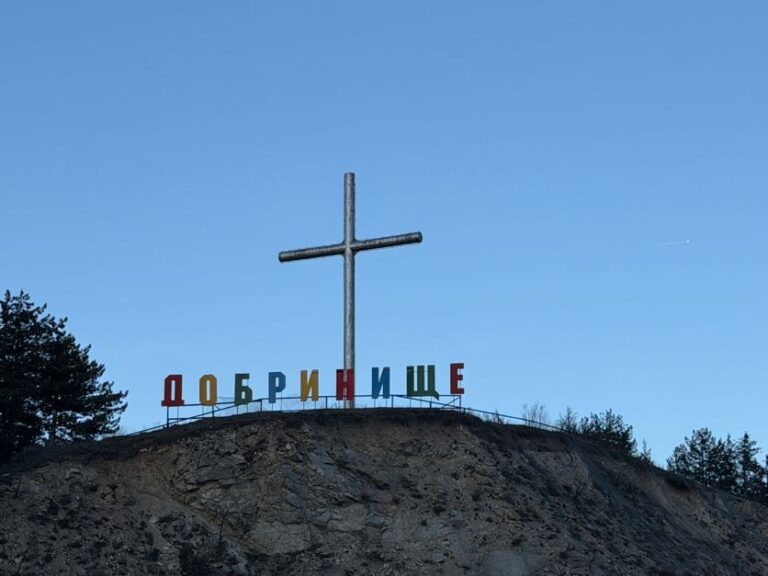
| The hill above Dobrinishte | A 12-meter illuminated cross with an incredible panorama of Pirin, Rila and the Rhodope Mountains. | Erected around 2010 on the initiative of the local authorities (Mayor Nikola Sakarev) as a guardian over the city and the mineral springs. |
| village of Petrelik (Blagoevgrad region) | A 15-meter illuminated cross in the Sveta Petka area. Visible all the way from the border with Greece. | Erected by volunteers after a prophetic dream of a former mayor at an ancient holy site to protect the village. |
Similar glowing crosses can be seen in other mountain towns in Bulgaria such as Panagyurishte, Velingrad and Smolyan, which proves that this is a national, not just a local, trend.
Attention: Tips for mountaineers and tourists
Although most crosses are accessible via established eco-trails or dirt roads, if you decide to visit them at sunset (for the best photos), be sure to wear headlamp or flashlight, warm clothes (the wind on the hills is strong) and sturdy shoes. During the winter months in Bansko and the region, the trails can be icy and dangerous.
The Tourist Potential: A Walk with a Cause
In addition to their spiritual significance, illuminated crosses are quickly becoming attractive tourist destinations. They offer the perfect combination of gentle physical exertion, cultural enrichment, and visual delight. Many of them have been surrounded by wonderful infrastructure by local municipalities:
- Panoramic platforms: Ideal for photography enthusiasts, especially during the "golden hour" before sunset or for long exposure night shots.
- Places for recreation and picnic: Gazebos, wooden benches, and even built-in barbecues invite families to spend a few hours in nature.
- Spiritual solitude: The small chapels built next to the crosses are always open. Anyone can light a candle, pray in silence and escape the commercial noise of the big resorts.
If you are in Bansko, the walk to the cross above Dobrinishte can easily be combined with a visit to the mineral pools in the town or with lunch in a traditional local tavern. For guests of Blagoevgrad, the climb to “Pamet i Vira” is a favorite afternoon ritual for the weekend.
Do you want to discover more of the magic of the region?
The next time you stand on your terrace on a cool Pirin evening and look up at the lights on the hill, think about it. Are you looking at just light bulbs on a metal structure, or are you seeing the light of faith of a people who have survived for centuries thanks to it? Regardless of the answer, these glowing sentinels are part of the soul of Pirin and are waiting for you to discover them.