



Bansko has long been more than just a popular winter resort, but a year-round home for thousands of digital nomads, expats and tourists from all over the world. With the growth of this diverse international community, local discussion groups on social networks have become a major barometer for the pulse of the city and the problems of its residents. One of the topics that traditionally arouses great interest and active debates is the presence of stray animals. 3 days ago in the popular English-language Facebook group Bansko Notice Board A serious discussion on the topic has erupted. The post, which has garnered over 42 reactions and 40 comments in just a few hours, raises the pressing issue of street safety, but also animal welfare.
The good example: Most stray dogs in Bansko are completely safe
Before we look at the specific issue that stirred up the spirits, it is extremely important to set the right context. Bansko is a city with a large population of street dogs, but the truth is that the vast majority of them are completely safe, well-socialized and extremely friendly. The coexistence between humans and animals here is usually more than peaceful.
Many of these four-legged residents are neutered, tagged and cared for by locals, restaurant owners and foreigners themselves. They can often be seen lazily sleeping in the sun in front of supermarkets or accompanying tourists on the trails to the Pirin Mountains, hoping for a treat. Expats themselves often become attached to them. The discussion gives as an example one of the largest and most fearsome-looking dogs in the city – known among foreigners as Baridu. Despite its size, the bear is described as a “gentle giant” who is a favorite of the community. However, problems begin when territorial instincts overpower socialization.
When instincts prevail: Territorial aggression on Drama Street“
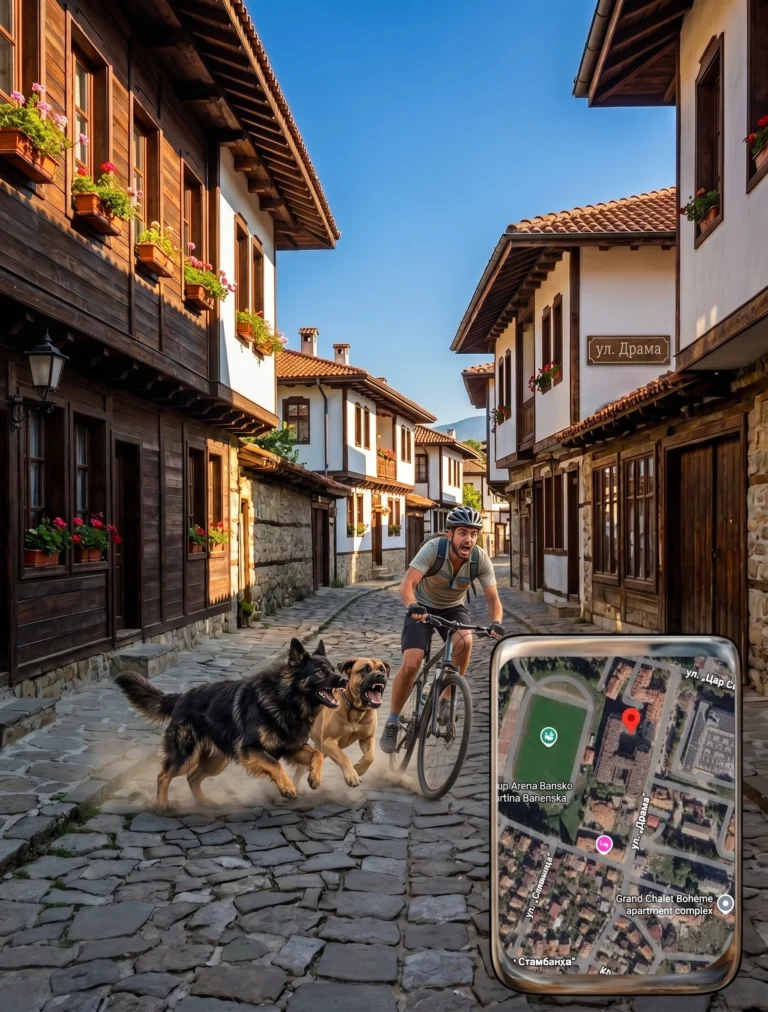
The focus of the current anxiety among the foreign community falls on one specific area in the city – Drama Street. The author of the publication, the user Sarah, describes a chilling experience with two specific dogs – a large black and a smaller brown female. According to the observations of those living nearby, the animals have permanently settled in front of a private house, in the yard of which five Labradors are kept. The street dogs have recognized the sidewalk and the street in front of the property as their personal “territory” and zealously guard it from intruders, with the most serious trigger for their aggression being passing cyclists.
“At first, they only barked at us in the evenings, but that day things escalated. The black dog started chasing my bike and its teeth were frighteningly close to my 4-year-old, who was sitting in the back seat. I realize that I could have reacted more adequately, but I literally had a second - I screamed like crazy and rode as fast as I could to protect my little one. During this time, I left my 9-year-old son on his bike behind us. Luckily, the dog was so focused on chasing me and my daughter out of his 'new home' that he didn't pay attention to my son.‘
Timeline of Fear: Not an Isolated Case
When it comes to child safety, isolated incidents can be chalked up to bad luck, but the comments below the post reveal a clear and systemic problem in this particular area. The discussion brings to light more troubling facts:
- Attack on other pets: Themselves Sarah shares in her comments that she had another close encounter with the black dog in question. While she was walking her own puppies on foot, it chased her again. This time, she only avoided a physical confrontation thanks to the fact that she was carrying a stick with her to scare it away.
- Physical injury: According to information shared by her neighbor, the problem is much deeper. The woman said that recently a child from Sofia was actually bitten in the exact same place. Because of this incident a few weeks ago, the police were even called to the scene.
- Constant harassment of cyclists: Locals confirm that the duo of dogs constantly bark, jump up aggressively, and chase passing children and adults with bicycles. The fast movement and spinning tires apparently trigger a strong hunting instinct in the animals.
Empathy vs. Fear: What's the Solution?
One of the most impressive aspects of this discussion is the mature and extremely humane position of the affected expats. Despite the adrenaline shock and the real danger to their children, the family of Sarah is categorical – they don’t want anything bad to happen to the animals. She herself notes that the dogs are not necessarily “evil”. When her sister (who has experience with street animals) walked through the area and calmly spoke to them, they showed no aggression.
The problem is rooted entirely in the unlocked territorial aggression and reaction to specific stimuli like bicycles and other dogs. They are simply following their primal instincts. However, their place is clearly not free on the street, where families and tourists pass by every day.
The foreign community's appeal to the Bansko Municipality and animal protection organizations is clear and constructive: the institutions must intervene in a timely manner and organize safe relocation of these two specific dogs to a shelter or other suitable environment. The goal is to prevent an inevitable future incident with more serious consequences, while protecting the lives and health of the animals themselves.
Your opinion is important!
Have you or your children encountered similar aggression from street animals in Bansko? Where do you think the line is between empathy for stray dogs and ensuring public safety? Do you think the municipality reacts quickly enough to such signals? Share your experiences and suggestions in the comments in our Facebook group.