

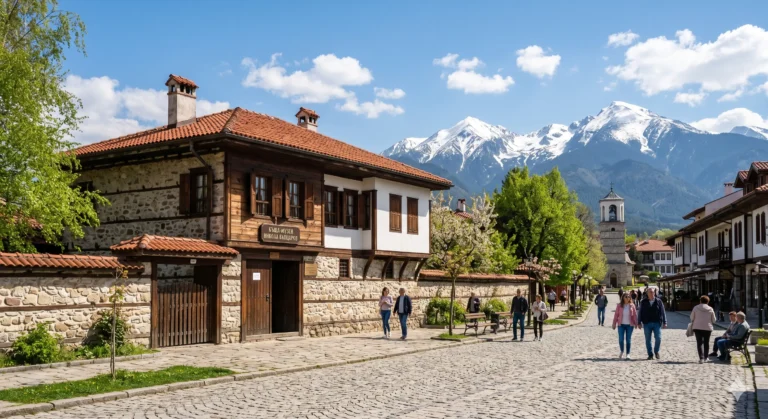
History of the family and the emblematic "Vaptsar House"„
Before it became a national museum in 1952, this building was the home of one of the most influential families in the region. The Vaptsarovi family takes its name from the trade of "vaptsars" (fabric dyers). The building we see today was built on the foundations of the old dye house, combining the typical Bansko Renaissance architecture with the functionality of a modern home for its time.
The home of Nikola Vaptsarov was the center of turbulent political and cultural events. The poet's father, Yonko Vaptsarov, is a legendary commander of the VMRO and a trusted man of the royal family. The mother, Elena Vesuvius, was among the most enlightened women in Bansko - a graduate of the American College, she was the person who instilled the love of literature and humanism in Nikola's soul.
Guests of the House: From Yavorov to Kaiser Wilhelm II
There are few places in Bulgaria that can boast such a list of guests. The great Peyo Yavorov, the poet Elisaveta Bagryana, as well as crowned persons such as Tsar Ferdinand and Tsar Boris III have passed through the threshold of the Vaptsar House. This rich intellectual environment shaped the worldview of the young poet and prepared the ground for his genius.
Nikola Vaptsarov: Life between machines and poetry
To understand the exhibition at the House-Museum, you need to look at Nikola Vaptsarov not only as an author, but also as an ordinary person struggling with the difficulties of the era. Born on December 7, 1909, his path is marked by the dream of art and the harsh reality of labor.
The sea and machines as inspiration
Despite his desire to study literature, at the behest of his father, Nikola graduated from the Naval Engineering School in Varna. His period of internship on the ship "Burgas" allowed him to see the world - from Istanbul to Port Said. These trips gave birth to the maritime motifs in his poetry and gave him insight into global injustices.
The Exhibition: An Innovative Experience in Bansko
The Nikola Vaptsarov House Museum“ in Bansko is unique in that it is not just a static collection of objects. Thanks to the concept of the great director Valo Radev, the renovated exhibition uses light and sound effects to immerse the visitor in the atmosphere of Vaptsar's time. Here, "Motor Songs" are not just read, they are experienced.
| Hall / Floor | Highlights of the exhibition |
|---|---|
| First floor (Video room) | Films about the poet, a family tree and personal belongings of his mother Elena. |
| Second floor (Home) | Authentically restored drawing room, living room and bedroom of the Vaptsarov family. |
| Creative halls | The first edition of "Motor Songs", the World Peace Prize (1952). |
| The Sanctuary | The suit and shirt the poet was wearing at the time of the shooting. |
Practical information for tourists – Season 2026
The visit of The Nikola Vaptsarov House Museum“ is easily accessible to every guest of Bansko. The museum is located on the central square and is open year-round.
- 📍 Address: Bansko, Nikola Vaptsarov Square No. 3
- ⏰ Working hours: 08:30 – 13:00 and 14:00 – 17:30 (no day off in active season)
- 🎟️ Entrance fees: Adults – 5.00 BGN, Students/Pensioners – 2.00 BGN (prices are approximate for 2026)
- 🎤 Conversation: We highly recommend paying for a talk (10.00 – 15.00 BGN) to learn details that are missing from textbooks.
What else is there to see nearby?
After visiting the Vaptsarov Museum, you can continue your cultural walk around Bansko. Just a 5-minute walk away are:
- Holy Trinity Church: One of the largest spiritual monuments in Bulgaria.
- Velyanova's house: A unique example of mural decoration from the Renaissance era.
- Neofit Rilski House-Museum: The birthplace of the patriarch of Bulgarian writers.
Conclusion: Why is this museum a must-see?
The Nikola Vaptsarov House Museum is not just a tribute to the past. It is a lesson in faith – faith in man, in progress and in „life better than a song“. In the age of rapid consumption, touching the authentic sacrifice and ingenious words of Vaptsarov has a purifying effect. Bansko is not just ski and taverns – Bansko is spirit and memory!