
Whether you are a citizen of the European Union or from a non-EU country, the residency rules are strict and time-bound. In this guide, we will take a detailed look at how it works. migration directorate Bansko, what are the differences between the procedures in the city itself and the regional center Blagoevgrad, and how to avoid the most common mistakes that lead to fines.
Bulgarian law requires registration of every foreigner within a short period of time. Failure to do so may result in administrative sanctions, refusal to renew residency, or even deportation in extreme cases.
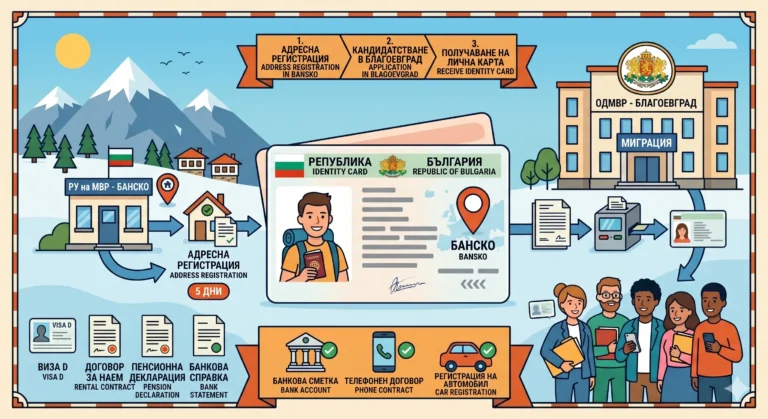
1. First steps: Address registration in Bansko (Time limit: 5 days)
Every foreigner who arrives in Bansko for more than a few days must declare their address. This is the so-called "address registration".
For tourists and short stays
If you are staying in a hotel or licensed apart-hotel, the administration is required to register you in the unified system of the Ministry of Interior automatically. Always request confirmation that this has been done.
For tenants and property owners
This is where things get more serious. If you have rented an apartment through a long-term contract or have purchased your own home, you (along with the owner, if you are a tenant) must visit the Ministry of Interior Bansko. You have 5 working days from the moment of entering the country to do this.
- Required documents: International passport, rental agreement or notarial deed.
- Important notice: If the owner cannot come with you, they must provide you with a notarized declaration of consent.
2. Residence permits: Types and procedures
The procedure depends entirely on your passport. Bulgaria applies different rules for EU citizens and so-called "third-country nationals".
A. Citizens of the European Union
If you are an EU citizen, the process is relatively easy. You are allowed to stay in Bansko for up to 90 days without any formalities (except for address registration). After this period you must take out Long-term residence certificate (valid for up to 5 years).
The main requirements are: to be employed, to have your own business, to be a student, or to have sufficient financial resources and health insurance so as not to burden the social system.
B. Third-country nationals (USA, UK, Israel, etc.)
For you, the path begins at the Bulgarian consulate in your country with the receipt of Type D visa. Without this visa you cannot apply for a residence permit in Migration Directorate Bansko/Blagoevgrad.
The most popular reasons for residing in Bansko for non-EU citizens are:
- Sales representative: Registration of a representative office of a foreign company at the Bulgarian Chamber of Commerce and Industry (BCCI).
- Pensioners: For persons who receive a pension in their home country and have sufficient means of living in Bulgaria.
- Investors: Individuals who have invested in real estate or business projects (according to specific legal thresholds).
3. The Bulgarian ID Card: Your “ticket” to a normal life
After your residency is approved, you will be issued a foreigner's identity document. This is not just a plastic card, but the document that entitles you to:
- Opening an account in a Bulgarian bank (very difficult without this document).
- Signing contracts with mobile operators and internet providers.
- Access to health services and registration with a personal physician.
- Purchase and registration of a car in your name.
4. Logistics: The journey to Blagoevgrad
Since the Migration Sector is located in Blagoevgrad, you will need to plan at least 2-3 visits. The first is for submitting documents, the second for taking biometric data (photo and fingerprints), and the third – to receive the finished card.
The road from Bansko to Blagoevgrad takes about 45-60 minutes by car. If you do not have personal transport, you can use the regular bus lines that leave from the Bansko bus station almost every hour.
5. Official contacts and locations
For your convenience, we have collected the necessary contact information for the institutions that serve the Bansko region.
👮 District Administration (DA) – Bansko
Use for: Initial address registration (up to 5 days).
📍 Address: Bansko, 39A Glazne Street
📞 Phone: +359 749 88 660
🛂 Migration Group – Blagoevgrad
Use for: Applying for an ID card and residency.
📍 Address: Blagoevgrad, 3 Vlado Chernozemski Street
📞 Phones: +359 73 867 502
📧 Email: [email protected]
🌐 Website: mvr.bg/blagoevgrad
6. Practical advice from local experts
Dealing with the government in Bulgaria can be intimidating due to the language barrier. Here's how to prepare:
- Translator: Most employees in Blagoevgrad do not speak English fluently. Hiring a translator or having a Bulgarian friend accompany you is highly recommended.
- Translation and legalization: All documents from your country (e.g. criminal record certificate) must have an Apostille and be translated by an authorized translator in Bulgaria.
- Working hours: Counters usually operate from 08:30 to 17:30, but they have lunch breaks and often stop accepting documents 30-60 minutes before the end of the working day.
- Payments: There are POS terminals on site, but they are often out of order. Always bring some cash for bank fees.
Living in Bansko as a foreigner is an incredible adventure, but the security of your legal residence is the foundation you need to build on. Be proactive, respect the deadlines of Bansko Migration Directorate and enjoy all that our mountain town has to offer.
Do you need assistance with documents?