



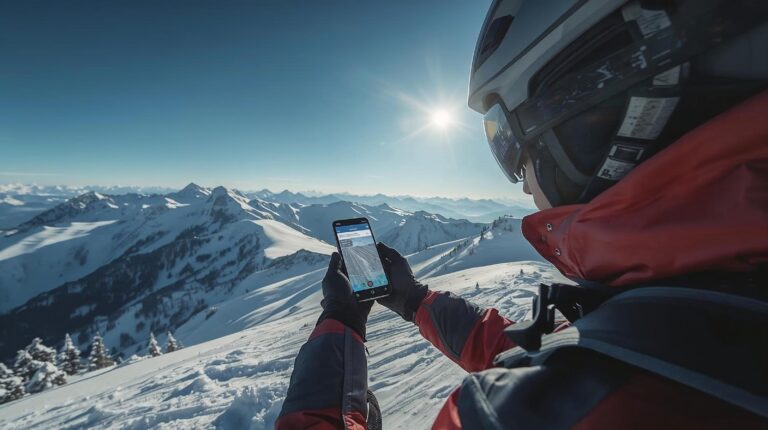
To return from your ski vacation in Bansko With robust equipment and a full photo gallery, we have prepared this detailed guide. Here you will find everything from battery chemistry to the best software tools for survival in Pirin.
Why does your phone need special care when skiing?
In sub-zero temperatures, the laws of physics work against your smartphone. Materials become more fragile, the liquid crystals in the screen slow down, and the battery loses capacity in seconds. In Bansko, where temperatures on Mount Todorka often drop below -15°C, these risks are an everyday occurrence.
1. Battery: How to prevent sudden shutdown?
Almost every skier has encountered the phenomenon: you take out your smartphone to film a descent on the “Tomba”, and the device turns off, although a minute ago it was showing 50% charge. The reason is lithium-ion batteries.
These batteries rely on electrolytes that thicken in the cold. This increases internal resistance, the voltage drops, and the phone's controller activates a protective shutdown to prevent damage. Here's how to deal with it:
- 🌡️ Body heat is the key: When skiing, always keep your phone in an inside pocket, located as close to your body as possible (on top of your thermal underwear or fleece).
- ✈️ Airplane mode: In the mountains, the range is often unstable. When the phone is constantly searching for a network, it consumes a huge amount of power. Activate Airplane Mode, but leave the GPS on – it works passively and doesn't waste as much power.
- 🧶 Additional insulation: If your jacket doesn't have a thermal pocket, use a small neoprene sleeve or even a wool sock. This will slow down the cooling of the shell.
2. Safety and placement: Where to keep the device?
The place where you store your phone while skiing, can be the difference between a minor injury and a serious one. A smartphone is a hard object that, when hit, acts like a hammer on your body.
| Carrying place | Risk to the phone | Risk to the body |
|---|---|---|
| Back pocket on pants | Critical (breaks when sitting) | Tailbone injury |
| External chest pocket | High (direct hit) | Broken rib |
| Inner pocket (under the arm) | Minimum | Minimum |
3. Software Preparation: Top Skiing and Safety Apps
Your phone is a powerful tool when skiing, as long as you have the right software. In Bulgaria, and specifically in the Bansko area, some apps are absolutely must-haves.
PSSS – Your Helpline
This is the most important application. It allows you to contact the Mountain Rescue Service and automatically sends your exact GPS coordinates via SMS. In a situation of dense fog or an off-piste accident, this saves lives.
Slopes and Ski Tracks
If you love statistics, these apps are for you. They track your top speed, elevation gain, and number of descents. Slopes features incredible 3D maps of the Bansko resort, which you can browse after the end of the day.
Fatmap: For the adventurous
For freeriders, Fatmap is indispensable. The application offers detailed 3D relief and shows the slope gradient, which is critical for assessing avalanche danger in Pirin.
4. Protection against moisture, condensation and snow
Even if your phone is IP68 certified (water resistant), snow and subsequent melting can still get into the charging ports or speakers. However, the biggest enemy is the condensation.
When you enter from the cold air into the warm tavern or teahouse of Banderishka Polyana., microscopic drops of water form on the internal parts of the phone. Expert tip: Don't take your phone out as soon as you get inside. Leave it in your jacket pocket for at least 15 minutes to gradually warm up.
💡 Professional trick for 50 cents
The best protection for your phone while skiing is a regular Ziploc bag. It protects against snow and moisture, but at the same time allows you to use your touchscreen without any problems. This is a must-have accessory for every freerider.
5. How to photograph in the mountains without wasting time?
Taking out your phone while skiing often leads to dropping it. To avoid this:
- Voice commands: Set up Siri or Google Assistant to take photos using your voice.
- Sound buttons: Use the physical volume up/down buttons as a camera shutter release – it's much easier with gloves.
- Safety rope: There are specialized cases with a neck or wrist strap. Even if you slip, the phone will stay attached to you.
6. Morning checklist for the skier
Before you board the gondola, make sure you're ready for the day. Here's our checklist:
- Charge: Phone on 100% + small external battery (Power Bank).
- Lift card: Always in your left pocket, away from your phone (magnetic fields can sometimes interfere with the reader).
- Insurance: Take a photo of your mountain insurance policy and save it to “Favorites”.
- Location: Share your location in real time with your riding friends via Google Maps or WhatsApp.
Prepare well, take care of your technique and enjoy every turn on the white slopes of Pirin! Yours phone while skiing should be a useful assistant, not a cause of stress.