



Every minute lost due to distractions from passersby, blocked paths or unauthorized actions can cost a life. The mountain does not forgive mistakes, and rescue operations are carried out under enormous pressure and stress.
Why is the role of witnesses so important?
When we witness an incident, the primary human reaction is often dictated by curiosity or a misunderstood desire for help. In their panic, people tend to make irrational decisions. The rescue teams of the MSS - Bansko go through long and exhausting years of specialized training to know exactly how to approach each situation. Their coordination is perfect, and their communication is free of unnecessary emotions. The intervention of outsiders destroys this fragile balance.
That is why knowing the basic rules of conduct during a rescue operation in the mountains is absolutely mandatory for anyone who steps outside the city limits, regardless of whether it is on an organized ski tour, freeride downhill or a summer walk to Vihren Peak.
🚫 What NOT to do during a rescue operation
Let's start with the most common mistakes that can seriously endanger both the victim and the rescuers themselves.
1. Stop filming and don't live stream
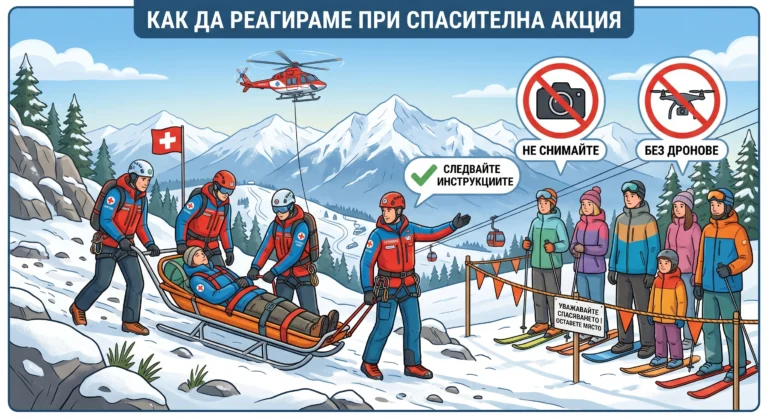
In the age of social media, the instinct to pull out your smartphone is almost automatic. However, this is unacceptable during an incident. Taking a picture of an injured person is a gross violation of their personal space and dignity. No one wants their most vulnerable, painful and scary moment to be broadcast on the internet. Additionally, pointed cameras and phones create extremely unnecessary stress on the EMS teams, who need to be fully focused.
2. GROUND the drones immediately!
If you are flying a drone in the area of the incident, Land it right now.. Helicopter air evacuation is often the only way to quickly transport a critically injured patient. Drones pose a huge, deadly threat to the rotors of rescue helicopters. Even a small drone can cause a crash of the machine or force the pilot to abort the mission, leaving the injured person without help.
3. Keep unsolicited advice to yourself
Even if you have basic first aid knowledge or are a medical professional, your intervention may be unnecessary. Rescuers follow strict mountain medical protocols that differ from urban conditions. Do not interfere, give advice, or interrupt their work unless the incident leader specifically asks you for expert assistance.
4. Avoid unnecessary questions and noise
Questions like “What happened to him?”, “Is he alive?” or “Where did it fall from?” only waste the team's valuable time. Also, don't shout or make noise. Communication between rescuers, especially in severe weather conditions, strong winds, or when using avalanche dogs, is key. Dogs rely on their sense of smell and hearing, and unnecessary chaos confuses them.
✅ What TO do to help rescuers
Inaction is often the best help. However, there are specific steps you can take to secure the perimeter.
1. Clear the perimeter and provide a corridor
If you are on a ski slope or a narrow mountain path, immediately move as far to the side as possible. Provide the widest and clearest possible corridor for sleds (akias), snowmobiles or hiking teams to pass. Warn people around you to do the same.
2. Prepare for air evacuation (Helicopter)
If you hear or see a rescue helicopter approaching, you must react quickly. The air flow from the rotors is extremely powerful (it can reach hurricane speeds of over 100 km/h). Crouch low to the ground at a safe distance (at least 50-100 meters from the landing site). Be sure to pack away all loose items. – hats, scarves, gloves, poles and fasten your backpacks well. An object flying in the jet stream can become a deadly projectile or damage the machine's engine.
3. Control your pets
If you are on a summer hike with your dog in Pirin National Park (which should generally be on a leash), keep him close to you and calm him down. A barking or loose-running dog can provoke an accident or distract the specially trained rescue dogs of the Bulgarian Rescue Service who are searching for people buried under an avalanche.
4. Take care of your own safety
Don't become a second victim. Often, bystanders will get dangerously close to the edge of a cliff, cliff face, or avalanche-prone slope to see what's happening. Rescuers don't have the capacity to handle two simultaneous incidents in the same place. Stay in the safe zone.
If you are the first on the scene of the accident
Sometimes we are the first to encounter a casualty before the EMS has been notified. In this case, your actions in the first few minutes are critical.
- Report immediately: Call 112 or directly to the Central 24-hour Emergency Response Center at 02 963 2000. If you have the MES mobile application installed, use it - it automatically sends your exact GPS coordinates to the on-duty team, which saves hours of wandering.
- Secure the place: If you are on a ski slope, drive two skis into an “X” shape about 10-15 meters above the injured person. This signals oncoming skiers to slow down and go around.
- Prevent hypothermia: In the mountains, the cold is the biggest enemy of a traumatized person. Isolate the injured person from the cold snow or ground. Place a backpack, jacket, or rescue foil (aluminum blanket) under him and cover him with whatever you have.
- Do not move the person: Unless his life is in immediate and imminent danger (e.g. risk of falling rocks or a second avalanche), do not attempt to move him. With potential spinal or neck injury, any incorrect movement could cause irreversible paralysis or death.
Mountain Insurance: Your Personal Responsibility
It is important to note that mountain rescue operations are extremely expensive and resource-intensive. Hiring teams, equipment, dogs, and especially a helicopter costs thousands of leva. In Bulgaria, mountain rescue is not covered by standard health insurance.
That is why the presence of a valid mountain insurance is not just a recommendation, but a matter of personal responsibility. It ensures that if you get into trouble, the costs of your evacuation and first aid will be covered, and the EMS system will be able to continue to function and save lives without financial collapse.
Download the PESS app and get ready
-
For Android devices (Google Play Store): Download the PESS app for Android
-
For iPhone/iOS devices (Apple App Store): Download the PESS app for iOS
In summary
The mountain is a place of solidarity, respect and humility. The best help you can give to the mountain rescuers from Bansko, when they are already on the ground and conducting an operation, is provide them with space, peace and quiet to do their work. Their mission is sacred – they save lives. Our mission is simply to stay out of their way.