



Why is Velyanova's House a must-see stop?
It is the key to understanding the true spirit of Bansko from the Renaissance era - a time when the fear of raids went hand in hand with the immense wealth and refined taste of local merchants.
The Age of Insecurity: Architecture as a Shield
To understand the structure of Velyanova's house in Bansko, we must go back to the 18th century. At that time, the city was experiencing an unprecedented economic boom. Local merchant families controlled the markets in Budapest, Vienna and Leipzig. However, the wealth was a lure for Kardzhali gangs and robbers, which necessitated the construction of the so-called "banska fortified house".
Fortress walls and ramparts
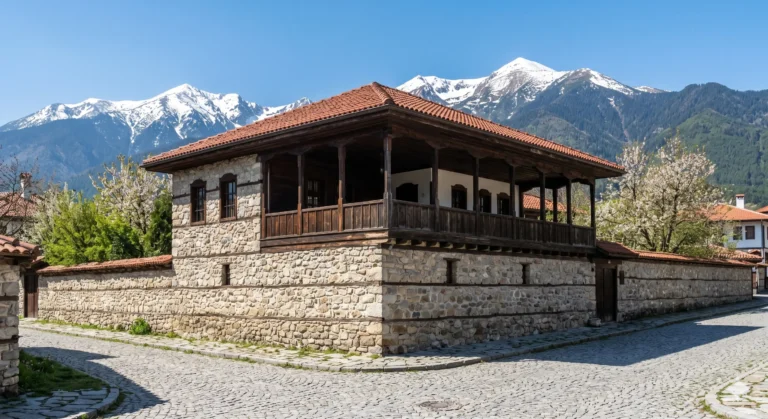
The ground floor of the house is built of massive river stone, the thickness of which exceeds one meter. These walls are designed to withstand shelling and siege. The windows here are minimal in size, protected by heavy wrought iron bars known as „"railroad"“. At key points on the facade, loopholes (mesh) were left through which the defenders could act effectively against attackers without putting themselves at risk.
Underground tunnels and hideouts
One of the most exciting secrets of the Velyanova House is its complex evacuation system. Under the floors of the rooms are hidden secret hiding places, connected to underground tunnels. These corridors allowed the inhabitants not only to hide in case of attack, but also to go unnoticed far beyond the boundaries of the property. This functionality turns the dwelling into a real citadel.
Master Velyan Ognev: The Genius Who Changed Everything
The history of the building changed forever in 1835. Then, in Bansko, Velyan Ognev (Usta Velyan), a representative of the legendary Debar art school. He was hired to paint the iconostasis of the Holy Trinity Church, but his talent impressed the local nobles so much that they gave him (or sold him on favorable terms) the old house of the Hadjiradonov family.
Velyan Ognev is not just a craftsman; he is a visionary with a European education. It is believed that he specialized in Italy, which explains the Baroque elements in his work. He transformed the austere stone building into an elegant home, inspired by his love for Sofia Benina.
„"The Blue Room": A Window to Europe
The real shock for the visitor comes on the second floor. While the exterior of the house is austere and unapproachable, the interior is an explosion of colors and shapes. The pearl in the crown is undoubtedly „"The Blue Room"“.
- ✔
Murals: Instead of traditional ornaments, Velyan painted the walls with panoramic landscapes from Venice and Istanbul. Expensive pigments based on lapis lazuli were used, which retain their brightness to this day. - ✔
The ceiling: The wood-carved ceiling is a masterpiece of the Debar School. The central rosette symbolizes the sun and is crafted with mathematical precision, creating the illusion of movement and depth.
Revolutionary conveniences for the 19th century
Velyanova's house was ahead of its time in terms of hygiene and comfort. The master remodeled part of the large veranda to create indoor sanitary facility – a bathroom and toilet with primitive but working sewage. In an era when hygiene was a challenge even in large European cities, people in Bansko enjoyed a domestic luxury inaccessible to many.
| Room | Function | Key element |
|---|---|---|
| Blue room | Guest room for important visitors | Landscape murals |
| Women's room | Daily life and childcare | Loom and hearth |
| Terrace | Recreation and socialization | View of Pirin |
Practical information for visitors (2026)
Are you planning a visit to Velyanova's house in Bansko? Here's what you need to know to make the most of your experience:
Location and parking
The house is located at 5 Velyan Ognev Street. The most convenient way to get to it is on foot from Vazrazhdane Square. The streets in the old town are narrow and cobblestone, which makes driving to the very entrance difficult. Use the public parking lots in the center.
Opening hours and tickets
The museum is open year-round. The entrance fee is affordable, and there are also combined tickets, including the Nikola Vaptsarov Museum and the Neofit Rilski House Museum. The talks are offered in Bulgarian, English and German.
💡 Expert advice for photographers:
The light on the second floor is best in the morning hours. The use of flash is strictly prohibited to protect the authentic paints from fading. Bring a wide-aperture lens for the details in the Blue Room.
Frequently Asked Questions (FAQ)
1. How long does the tour take?It usually takes about 45 minutes. If you join a talk, allow at least an hour.
2. Is it suitable for visiting with children?Yes, kids love the story of the secret tunnels. However, be careful with the steep wooden stairs.
3. What is Velyan Ognev famous for besides the house?He is the author of the wood-carved iconostasis and part of the frescoes in the Holy Trinity Church - one of the largest churches in the Balkans at that time.
Conclusion: Why visit Velyanova House today?
In a digital world, touching the authentic spirit of the Bulgarian Revival has a purifying effect. Velyanova House is not just an architectural object – it is proof that even in the darkest times of uncertainty, the pursuit of beauty and progress is relentless. The view from the veranda to the peaks of Pirin and the silence of the stone walls will make you feel the pulse of old Bansko in a way that no book can describe.