

Who is Neofit Rilski and why is his home so important?
Born in 1793 with the secular name Nikola Poppetrov Benin, Neofit Rilski is a figure of almost mythical dimensions in Bulgarian history. He was a Renaissance-style encyclopedist: monk, educator, linguist, translator, artist and musician. His mission was clear – to lead the Bulgarian people out of spiritual darkness through education and the power of the native word.
In his native house in Bansko He received his first lessons from his father, priest Petar. Here his indomitable spirit was formed, which would later allow him to compile the first Bulgarian grammar and organize modern secular education in Gabrovo. Today, the Benin House is a monument of national importance and part of the prestigious list of the 100 national tourist sites.
Interesting fact:
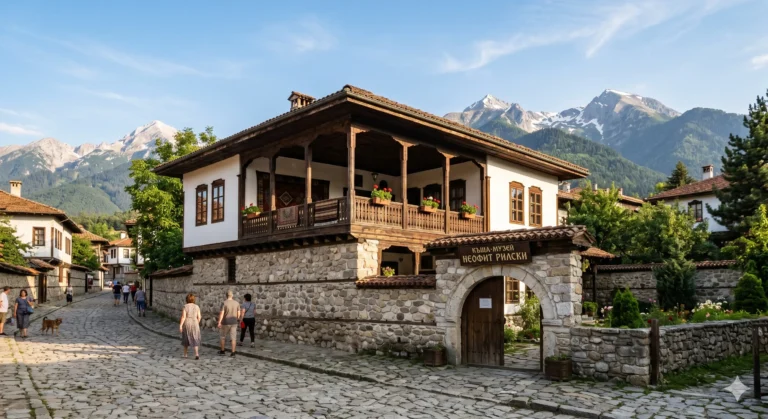
The Benin House is one of the few authentically preserved "fortresses" in Bansko. Its architecture reveals that in the past, the people of Bansko were not only wealthy merchants, but also people ready to defend their homes with weapons in hand.
The architectural genius of the Benin House
Built in the mid-18th century, Neofit Rilski House Museum„ is a classic example of a Bansko fortified house. During the Ottoman era, security was the number one priority. If you look closely at the walls, you will notice that they are over 1 meter thick, built of river stone and bonded with mortar, turned into a strong concrete mixture.
The fortress elements you will see:
- The Hideout (The Cashier): A specially fortified room on the ground floor with massive iron doors, where the family hid their valuables and took refuge during an attack.
- The secret tunnels: The house has exits that in the past led to neighboring buildings or to the courtyard, providing an escape route.
- The Battlefields: The small windows on the lower floor were not for light, but for defense - they could be fired through without the defenders being vulnerable.
Walking through the museum: What to expect?
The exhibition is organized to guide you through the personal life of the Benini family and the professional path of Neofit himself. The museum is divided into two main parts: ethnographic (life) and documentary (literary heritage).
The Ground Floor – The Spirit of Old Bansko
Here you will see the authentic kitchen with a double oven, called a "mesilnik". The large room that served as a monastery school is impressive. Imagine the children of Bansko, sitting on the ground, writing in the sand, while Neofit's father taught them to read and write. This was the first spark of knowledge in the region.
One of the most impressive elements on the ground floor is The Benini family tree. It is painted in the former outbuilding ("podnika") and shows the roots of this famous family, which has given so much to Bulgarian culture.
The Second Floor – The Treasury of Enlightenment
On the upper floor, which is reached by wooden stairs and a spacious veranda, is the documentary exhibition. Over 400 original documents and objects are kept here. Here are the most valuable among them:
| Exhibit | Meaning |
|---|---|
| Bulgarian Grammar (1835) | The first scientific attempt to codify the Bulgarian language. |
| Translation of the New Testament | The first accessible translation into modern Bulgarian. |
| Neophyte's Globe | A photo of the first Bulgarian globe, made by himself for his students. |
| Personal letters and stamps | They reveal his contacts with the most prominent intellectuals in the Balkans. |
Why is it worth visiting the museum right now?
In the age of digitalization, returning to roots offers unexpected peace and inspiration. Neofit Rilski House-Museum„ It's not just a dry story - it's a story about ambition. How did a boy from a small mountain town, without the internet or modern technology, manage to become the most educated Bulgarian of his time?
The visit is suitable for families with children, as the monastery school and the hiding places always ignite the imagination of little explorers. In addition, the museum is located meters from Holy Trinity Church„, which allows you to take a complete cultural walk through the oldest part of Bansko.
Practical information for visitors (2026)
To plan your visit as best as possible, keep the following information in mind:
- 📍 Address: 17 Pirin Street, Bansko (next to the church)
- ⏰ Working hours: 09:00 – 12:00 and 14:00 – 17:30.
- 🗓️ Day off: Tuesday
- 💰 Special offer: Every first Monday of the month the entrance is FREE.
Note: Neofit Rilski House Museum is part of the Bansko Museum Complex. You can purchase a combined ticket for all museums in the city, which will save you money and give you a complete picture of the local history.