



The discovery of the Thracian sanctuary in the "Stolovatets" area„
In 1971-1972, in the picturesque area of Stolovatets, located about 5 kilometers west of the town of Razlog, archaeologists came across an amazing find. Remains of an ancient Thracian sanctuary were discovered, dating from the end of the Bronze Age and the beginning of the Iron Age (about 2 thousand BC). The ruins of massive walls built of crushed stones are clearly visible at the site.
The real sensation, however, were the three large marble slabs found there with exquisite relief decoration, categorically related to the ancient cult of the Sun. Their arrangement was extremely specific:
- The big slab It lay diagonally face down (its narrow end pointed southwest and its wide end pointed northeast).
- About 2 meters away from it was a second slab, which unfortunately later disappeared.
- The third, smaller slab was discovered 5-6 meters to the northwest.
These finds are considered by scientists to be extremely valuable not only for the regional, but also for the world history of humanity, as they bear signs of cultural interaction with the Mediterranean area.
The Cult of the Sun, the God Hermes and the Thracian Chieftains
The marble slabs from Stolovatets are evidence of the widespread spread of the solar cult among the Thracians in the 2nd millennium BC. Of particular interest to researchers is a specific figure – a male image with a clearly pronounced phallus. Historians believe that this is how one of the main gods of the Thracians is depicted, later known by his Hellenic name Hermes. In Thracian mythology, he was worshiped primarily as the god of kings and tribal leaders.
The presence of such an image is conclusive evidence that the sanctuary belonged to a powerful Thracian chieftain. For a long time, archaeologists were puzzled by the lack of a fortified royal residence nearby. Only in 2008, during a thorough archaeological tour, was such a fortification discovered, dating back to the same era. This is one of the few Thracian fortified places from that time that have survived to this day.
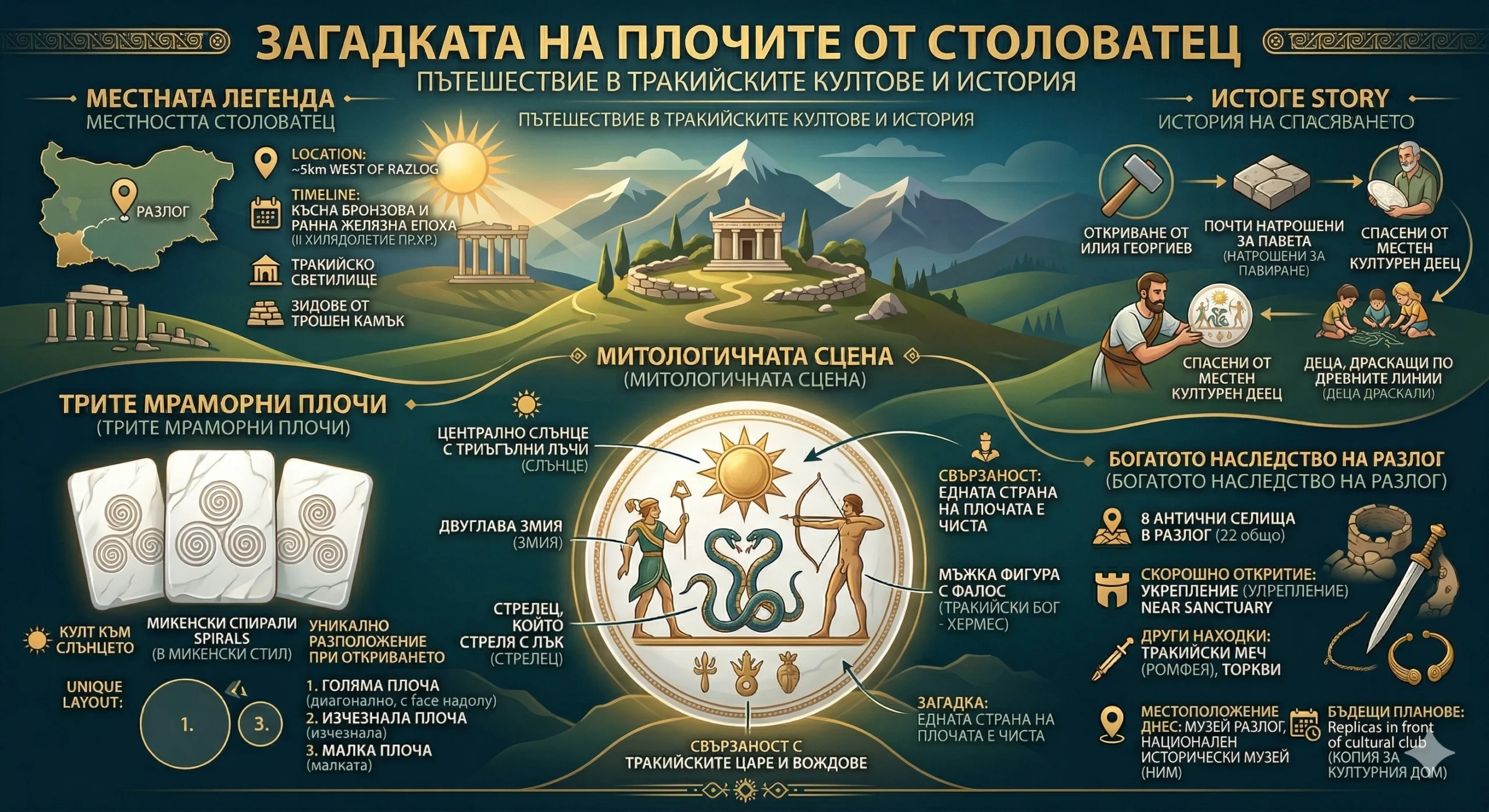
A visual infographic telling the story of the “Mystery of the Stolovatets Tablets.” It includes the local legend, the story of the rescue of the artifacts, a detailed analysis of the mythological scene with a central Sun, a two-headed snake, and a phallic figure, as well as the rich context of the ancient settlements in the Razlog Valley.
The incredible story of saving the plates
The fate of the large slab resembles a movie script. It was located in the field of local resident Iliya Georgiev Radushin, located on the highest and most prominent part of the area. For decades, he knew that a large stone with „patterns“ lay underground, but he had no interest in digging it up.
Everything changes when his neighbor decides to remove the slab. It is taken to the yard of a private house in Razlog with the absurd goal of breaking it into smaller pieces for paving the yard. Fortunately, it is noticed in time by a local cultural activist, who realizes its immense value and manages to transfer it to the museum.
Detailed analysis: What is depicted on the stone?
It is obvious from the first glance that the slabs from Stolovatets are extremely interesting and ancient monuments. The large slab is a massive stone block of white layered marble weighing about 1 ton. With a length of 170 cm, its thickness is between 13 and 13.5 cm. The specific shape (narrower at the base and expanding upwards) is a characteristic stylistic feature of the ancient Cretan and Mycenaean culture.
Spirals, meanders and Mycenaean parallels
The large upper part of the obverse surface is occupied by a huge ornament composed of vertical stripes:
- A triple-ribbon bundle that is wound meanderingly into four spirals.
- A net-like spiral ornament resembling the stone ceiling of the small burial chamber at Orchomenos (Mycenae).
- The master engraver has demonstrated an exceptional sense of symmetry and geometric harmony, balancing the intricate ornament in the irregular space of the plate.
The magical mythological scene
In the lower part of the slab, on a relatively small space, a magical scene with six figures is depicted. In the center is a sun with triangular rays. Beneath it is a monstrous two-headed snake. On the right, the profile of an archer is clearly visible, who has drawn a bow and is shooting straight into the open mouth of one of the snake heads. Researchers note that the human aspiration and the depiction of the phallic symbol carry deep mythological symbolism associated with fertility and power.
The rich past of the Razlog Valley
The Thracian sanctuary is not an isolated case. As many as 8 ancient settlements have been registered in the territory of the city of Razlog (from the 8th century BC to the 5th century AD), and in the entire municipality their number reaches 22. During excavations in an ancient necropolis (2 km east of the city), impressive artifacts such as a Thracian sword-rhompheia, six torques, fibulae and others were discovered.
Touch the mystery today
To preserve the memory and promote this incredible cultural wealth, the slabs from Stolovatets are being restored in their original size and patterns. Their copies will soon be placed on the green areas in front of the cultural center in the center of Razlog. There, every resident and guest of the city will be able to get up close and personal with this ancient mystery.
Visit the Historical Museum - Razlog and see the original live!