

Why does Bansko need staff from abroad?
Over the past decades, Bansko has established itself as a leading ski resort in the Balkans. With the expansion of the bed base and the opening of hundreds of new catering and accommodation establishments, the need for qualified and unqualified personnel has increased dramatically. At the same time, the domestic labor market in Bulgaria is failing to meet this demand.
Hoteliers and restaurateurs say that hiring foreign workers in Bansko involves significant initial investments, but it is the only way to guarantee the quality of the tourism service. The stability that foreign staff offer is invaluable for managers who need predictability for the upcoming winter or summer season.
Where do the new faces of tourism come from?
The geography of the employed personnel in the city is expanding with each passing year. While 5-6 years ago, it relied mainly on personnel from neighboring countries (North Macedonia, Serbia) or Eastern Europe (Ukraine and Moldova), today the exoticism is much greater. The cultural mix is impressive.
Main countries of origin
- Asia: Nepal, Indonesia, Sri Lanka, India, the Philippines, and Bangladesh. These countries have strong traditions in hospitality and customer service, and their workers are renowned for their discipline and loyalty.
- Central Asia: Kyrgyzstan, Uzbekistan and Tajikistan. Often preferred because of their proficiency in Russian, which is a bonus when serving tourists from Eastern Europe.
- Turkey: Mainly in specialized restaurants, spa centers (hammam) and the construction sector related to the maintenance of the bases.
What positions do they hold in local business?
Due to the natural language barrier (most do not speak Bulgarian, although many of them speak decent English), these employees rarely occupy front-line positions that require intensive communication with customers. Most often, they are the invisible but extremely important backbone of the hotel industry (the so-called. back of house).
Information panel: Most sought-after professions
According to recruitment agencies, foreign workers in Bansko are most often hired as: maids and hygienists, assistant cooks, cleaners, general maintenance workers, gardeners, bellhops and spa therapists (especially staff from Bali and Thailand for specialized massages).
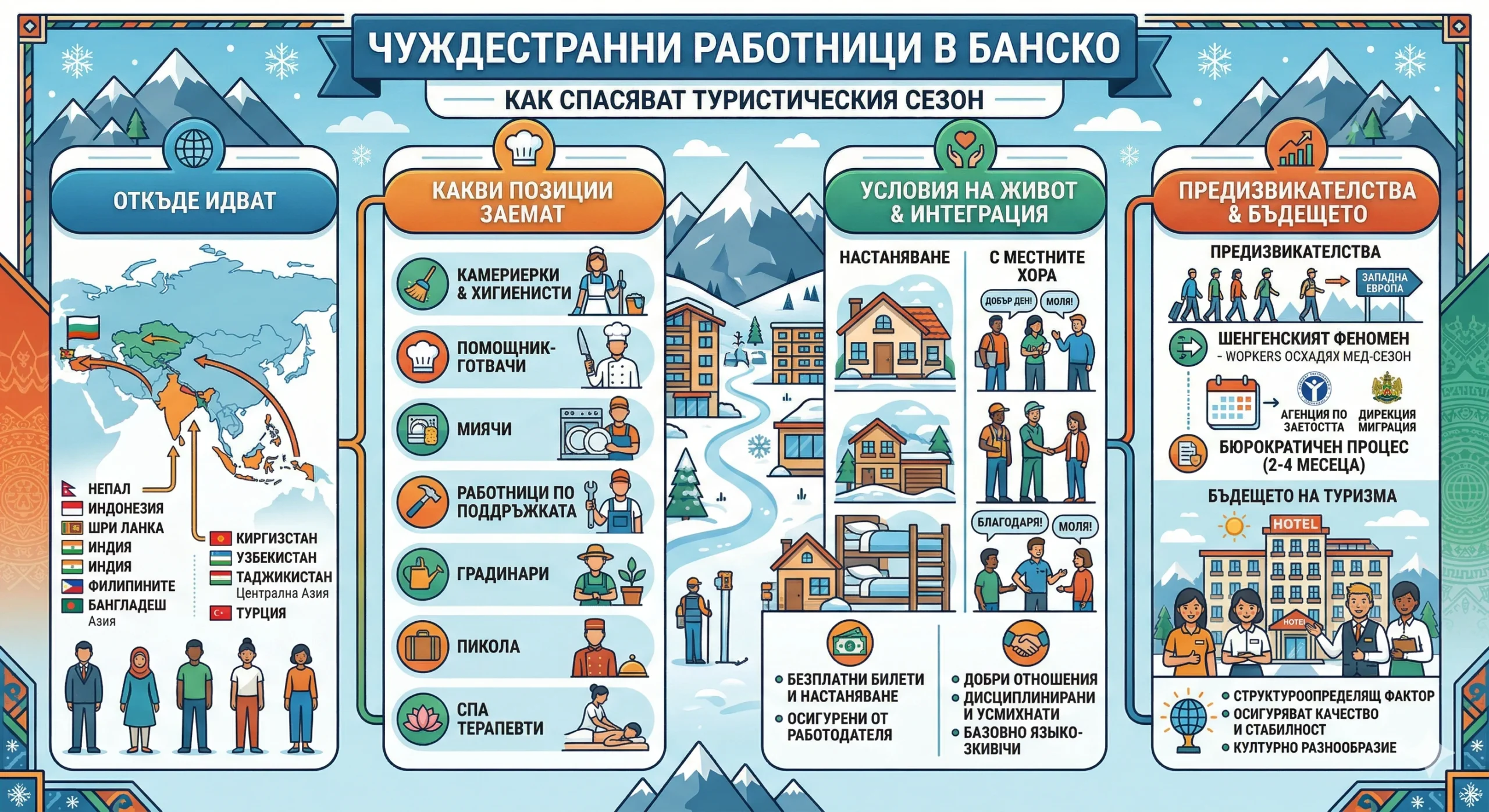
A comprehensive infographic that illustrates the vital role of foreign workers in Bansko in sustaining the tourist season. It covers their geographical origins, the positions they hold, their living conditions and integration into the local community, as well as the challenges and prospects facing the sector.
Where do they live and what is their rhythm of life?
Attracting talent from third countries is a major logistical challenge for local businesses. To attract and retain them, hoteliers and specialized employment agencies are required to cover the costs of airfare from the other side of the world, as well as work visa fees.
Accommodation is also entirely the responsibility of the employer. In Bansko and the neighboring town of Razlog, foreigners live under the following conditions:
- Specially rented guest houses: Many owners of smaller properties rent them out long-term to large hotels for staff accommodation.
- Separate dormitories: Large complexes build their own staff rooms within the hotel itself, which facilitates transportation and logistics of shifts.
Their rhythm is closely linked to the seasons. Most arrive in November to undergo mandatory training and adaptation before the big start of the ski season in December. An interesting fact is that when the snow melts in April, a large part of these people do not return to their home countries. Through agencies, they are redirected to the Bulgarian Black Sea coast (Sunny Beach, Golden Sands) to take over the summer tourist season, creating a perfect labor symbiosis.
How do they integrate and are they accepted by the locals?
The integration of foreign workers in Bansko has been extremely smooth. The locals are open-minded and accustomed to an international presence, thanks to the hundreds of thousands of tourists and the huge community of digital nomads who have chosen the city as their home.
Employers often don’t skimp on superlatives for their new hires. Workers from countries like Nepal, Sri Lanka, and Indonesia are known for their work ethic, proverbial politeness, and constant smiles even on the busiest days. Although communication on the streets, in shops, and supermarkets is mostly in English or through sign language, many of them quickly pick up basic Bulgarian phrases like “Good morning,” “Thank you,” and “Please,” which makes a great impression on the locals.
An important challenge: The Schengen phenomenon
After Bulgaria entered the Schengen area (by air and water), some local businesses are facing an unexpected problem. Some unscrupulous seasonal workers are using our country as a “springboard” to Europe. It happens that employees leave their jobs in the middle of the season, suddenly and without warning, heading to Western Europe in search of higher salaries. This creates serious headaches for hoteliers who have already invested thousands of leva in their import and training.
Is the hiring process complicated?
For every hotel manager in Bansko, it is clear that importing staff from third countries is a complex bureaucratic process. The procedure usually takes between 2 and 4 months. It goes through the Employment Agency, the Migration Directorate of the Ministry of Internal Affairs and the relevant consular services. Therefore, preparations for the winter season begin in the midst of summer.
Employers must prove that they have not found suitable Bulgarian citizens for the positions before being allowed to hire a foreigner. Because of these complications, most businesses prefer to work with specialized intermediary agencies that handle the paperwork and take care of the initial selection.
The future of tourism in the region
The fact is that foreign workers in Bansko are no longer just a temporary solution to a crisis, but a structural factor for the hospitality industry. Their presence ensures that hotel rooms will be clean, restaurants will function smoothly, and resort guests will receive the high level of service they expect from a European winter resort.
With their presence, these hardworking people from different parts of the world bring not only their professional skills, but also a piece of their culture, making Bansko an even more colorful, cosmopolitan and hospitable place for everyone.