



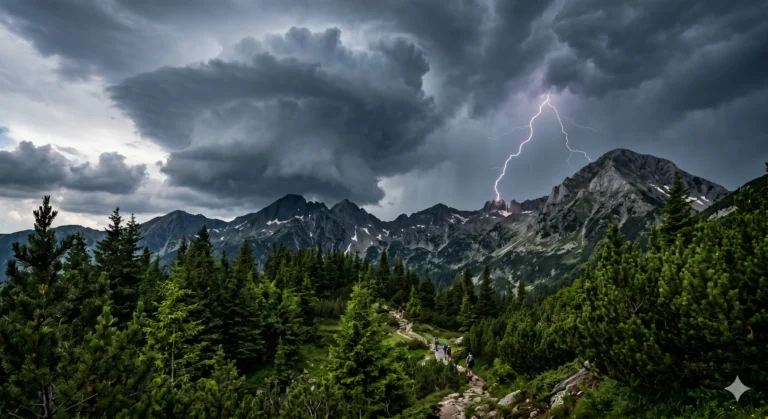
Why is a thunderstorm in the mountains so dangerous?
The specifics of the Alpine relief create perfect conditions for the rapid emergence of extreme weather anomalies. The warm and humid air that rises from the deep river valleys (such as those of Mesta and Struma) quickly cools down upon contact with the high granite and marble peaks of Pirin. This process leads to the formation of powerful cumulonimbus clouds (cumulus-rain clouds), which in the high parts can reach a vertical thickness of up to 15 kilometers, while in the lowlands they rarely exceed 8 kilometers.
The electrical energy stored in these cloud masses is greatly enhanced by the terrain. The electrical voltage between the base of the cloud and the ground can exceed 100 million volts. Sharp mountain peaks, rocky spires, and high ridges act as natural lightning rods, concentrating the intensity of the electric field. In addition to the immediate danger of a direct lightning strike, one thunderstorm in the mountains brings with it hurricane-force winds of over 140 km/h, large hail, sudden and sharp drops in temperatures (risk of hypothermia), and torrential rains. The latter can turn small mountain streams into raging, overflowing, and completely impassable water traps in minutes.
Expert advice for Bansko and the region:
Before each hike, get information directly from the Mountain Rescue Service base (MSS) in the town of Bansko or by the rescuers on duty at Vihren hut. Local weather conditions in Pirin often differ drastically from the general city forecast for the weather!.
Prevention: How to avoid the risks of a thunderstorm in the mountains
The best strategy for dealing with a disaster is to avoid it altogether. Proper planning and meticulous preparation are your most valuable safety tools in Pirin.
- Follow specialized mountain forecasts: Never rely on the mainstream weather apps on your phone that show a city forecast. Use detailed, high-resolution weather models that track atmospheric instability levels (CAPE index) and the probability of thunderstorm activity by the hour.
- The rule for early departure (“Up by noon, down by afternoon”): Cumulonimbus clouds usually develop as a result of daytime warming, with storms peaking between 2:00 PM and 5:00 PM in summer. The ideal schedule requires you to have climbed your target peak by 11:00 AM – 12:00 PM at the latest, then immediately begin a controlled descent into the forest area.
- Recognize risky days: If the air in Bansko in the morning is extremely heavy, stuffy and humid, this is a clear indicator of accumulated instability in the atmosphere. If there was strong thunderstorm activity the previous day, the probability of it being repeated with the same or greater force is huge.
Early signs of an approaching thunderstorm in the mountains
Nature always sends clear warnings before unleashing its full power. Your task as responsible mountaineers is to read them in time and react immediately.
Cloud morphology: Keep an eye on the horizon. Clouds that begin to grow explosively upward, forming massive vertical towers with flat tops (resembling an anvil), signal a mature cumulonimbus. When dark, gray-blue heavy streaks (virga or local showers) appear below the cloud base, the storm is already active.
Changes in the atmosphere and wind: A sudden cessation of the wind and the onset of a dead, eerie silence, followed seconds later by a cold, sharp gust from the opposite direction, is a sure sign of a storm front moving in. The increasing electric field in the environment can make the hair on your body and your hair stand on end. You may feel a slight tingling sensation on your skin or a metallic taste in your mouth.
Sound and physical phenomena: If you hear a strange buzzing, humming, or crackling sound coming from the tips of your trekking poles, carabiners, metal backpack zippers, or nearby rock edges, you are in the epicenter of a critically strong electric field. This is the “St. Elm’s Fire” phenomenon – lightning can strike in close proximity in a matter of seconds!
How to determine the distance to a dangerous thunderstorm in the mountains?
To find out what danger you are in, use the classic acoustic method. Since light travels instantly and the speed of sound in mountain air is about 340 meters per second, you can easily calculate the distance. Count the seconds from the moment the lightning flashes to the moment you hear the thunder and divide by 3 for kilometers.
| Time (seconds) | Distance (km) | Threat Level and Risk Assessment |
|---|---|---|
| Over 30 seconds | Over 10 km | Moderate threat. The storm is being monitored closely. |
| 15 – 30 seconds | 5 – 10 km | Increased caution. Begin rapid descent. |
| Under 15 seconds | Under 5 km | Critical danger! Immediately assume a defensive position. |
Immediate Action Protocol: What to Do in the Field
If the calculations indicate that time is running out and the front is above you, cease all forward and upward movement. Strictly follow the following emergency response steps:
1. Get down from high and open places
This is the absolute number one priority. Immediately leave bare peaks, sharp karst ridges and open plateaus. Since lightning usually strikes the most prominent point in the terrain, every meter of elevation gain reduces the mathematical risk of being struck. Aim to descend at least 30 to 50 vertical meters below the nearest dominant ridge within a few minutes. Look for sheltered spots, gullies or gullies that are not water beds.
2. Isolate and move metal equipment away
All metal objects – aluminum or carbon trekking poles, ice axes, crampons, carabiners, helmets and climbing equipment – should be collected. Pack them or place them on the ground at a safe distance of at least 15 meters away from you and the group. Metal itself does not attract lightning from kilometers away, but it acts as a perfect conductor, facilitating the passage of current and guaranteeing severe burns in the event of an indirect hit. Turn off mobile phones and store them deep in the backpack to prevent thermal damage in a strong induction field.
3. Adopt the correct protective posture (“Lightning Rod”)
If you don't have access to a secure and massively enclosed shelter, your only real choice is to minimize your body silhouette relative to the ground. Take low squat position:
- Crouch low to the ground, bending your head down toward your knee.
- Extremely important: Press your feet together tightly! Never stand with your legs apart and never lie down on the ground. When lightning strikes nearby, the current spreads radially along the surface of the soil, creating a potential difference between two points – this is called “step voltage”. If your legs are apart or you are lying down, the current will pass through one leg, pass through the vital organs (heart) and exit through the other, which is fatal. The feet together cause the current to pass only through your feet, closing the circuit locally in the soil beneath you.
- Sit or step on your backpack, dry rope, or other dry, insulating material to break direct contact with the ground.
Rules of conduct for group hikes
When you share the hike with friends or are part of an organized hiking group, collective discipline saves lives during the thunderstorm in the mountains.
Keep your distance: Spread out at least 20 to 30 meters (66 to 100 feet) apart. Crowding increases the overall electrical conductivity and heat flow, which can attract lightning. Additionally, if one member of the group is struck, the others will be unaffected and will be able to immediately administer first aid, artificial respiration, and cardiopulmonary resuscitation (CPR).
Resource allocation: Make sure in advance that the first aid kit and communication equipment are not gathered in one place. Group members must maintain complete self-control - panic in alpine terrain leads to slips, falls and serious injuries, which are statistically a more common cause of accidents in Pirin than lightning itself.
Where are the risks highest and where should we seek salvation?
Microrelief assessment is key when choosing an emergency location. Knowing the dangerous and safe zones will help you make a quick and adequate decision.
The most dangerous locations in the mountains:
- Single, isolated trees: Lightning is over 50 times more likely to strike a lone tree than a person on an open ridge. Standing under such a tree waiting for the rain to stop is a critical mistake.
- Water pools and wet chutes: Lakes (such as Banderishki, Prevalski or Popovo Lake), rivers, streams and wet rock gullies conduct electricity over vast distances.
- Shallow rock niches and caves: Never hide in shallow caves or under rock ledges where you don't have enough space. Your body can act as a bridge for an electric arc that travels from the ceiling to the floor of the cave. You can only enter a cave if it is deep and you can stand at least 1.5 - 2 meters away from the walls and ceiling.
- Artificial metal structures: Metal railings, ladders, chains on shelters or safety ropes on alpine routes in Pirin (for example, on the road to the Koncheto or Strazhite shelters).
Relatively safe areas for shelter:
- Massive buildings with lightning rods: Mountain huts (such as Vihren hut, Banderitsa hut, Yavorov hut, Demyanitsa hut, Bezbog hut, Sinanitsa hut) or shelters (such as Koncheto hut or Tevno Lake) offer the highest level of protection.
- Dense forest vegetation: Entering a dense, uniform forest, where the trees are approximately the same height, is relatively safe. Choose a position between the trees, but away from their trunks and crowns (at least 5-6 meters from the nearest tree).
- Closed cars: If the storm hits you near the parking lot of Shiligarnika or Vihren hut, getting into a car with a hard metal roof is perfect protection. The car acts as a Faraday cage - the electrical charge passes through the metal body and goes safely to the ground. Close the windows and do not touch the metal parts of the passenger compartment.
Correct behavior after the storm passes
One of the most common mistakes is leaving shelter too early. Lightning can strike from the front and back of a cloud system, even when the main rain has stopped and blue skies are visible. Strictly observe the 30 minute rule: stay in a safe place for at least half an hour after you heard the last thunder or saw the last lightning.
After the front passes, immediately put on dry and warm clothes (thermal underwear, fleece, membrane jacket), as temperatures in Pirin after a thunderstorm drop dramatically, and the risk of hypothermia is extremely high. Check the condition of your companions and if everything is fine, begin a careful descent to the nearest starting point in Bansko or Dobrinishte.
Mountain tourism in Pirin brings indescribable joy and freedom, but nature always requires humility and a high culture of safety. Knowing the rules for responding to a thunderstorm in the mountains is an investment in your life. Be prepared, read the signs of the weather and make smart decisions to always return home safely.