

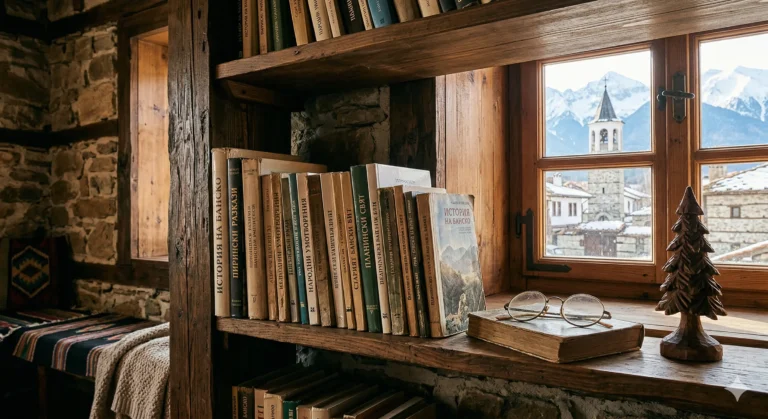
Why is the literature about Bansko unique?
Unlike many other regions, Bansko has a “closed” and extremely strong ancestral memory. The books here are not just dry facts, but emotional chronicles of survival, trade with distant lands, and the spiritual awakening of an entire nation.
Historical and local history fundamental works
When we talk about serious research and books about Bansko, we can't help but start with the monograph “Bansko – a spiritual center through the centuries” by Mihail Enev (2002). This is the work that puts the city on the map of the great cultural centers of the Balkans. In its 240 pages, Enev analyzes how the small mountain village became an economic and spiritual colossus.
Another key headline is “Bansko” by Lyudmil Tsankov (1999). This book is a real visual feast. It is ideal for people who want to see Bansko through the lens of the time, as it includes invaluable illustrative material showing the authentic appearance of the city before mass globalization.
For connoisseurs of antique finds, Dimitar Krastev's work from 1959, simply titled “Bansko”, remains an unsurpassed archive. Divided into parts such as “The Legend of the Beginning” and “The Fortress of the Bulgarian Spirit,” the book carries the pathos of its time, but is full of details that later authors often omit.
Ancestral Memory and Memoirs: The Living Chronicles
One of the most exciting aspects of local literature is the family chronicles. “For Renaissance Bansko, Sofia and the world… Chronicles of a family” by Lazar Hadzhivalchev is an epic tale spanning 300 years. Hadzhivalchev doesn't just write history; he conveys the pulse of a family whose roots are woven into the very fabric of the Bansko land.
Critically important for understanding the Bulgarian Renaissance is the book by Ekaterina Boyadzhieva – “Bansko and Mount Athos: The Mission of Hadji Valcho”. Here the little-known but fundamental role of Paisii Hilendarski's brother is revealed. Hadji Valcho is the figure without whose financial and logistical support "Slavo-Bulgarian History" would perhaps never have reached us in its present form.
List of top 5 must-read books for Bansko
| Title | Author | Topic |
|---|---|---|
| Bansko – a spiritual center | Mihail Enev | History and Culture |
| Todorka's Fireflies | Dimitar Sugarev | Skiing and Tourism |
| The foot of Perun | Maria Radonova | Biographies and Personalities |
| Rhodope Narrow-Gauge Railway | Christian Vaklinov | Transportation and History |
| Motor songs | Nikola Vaptsarov | Classical poetry |
Architecture and Faith: The Symbols of the City
You can't understand Bansko if you don't know the history of the Holy Trinity Church. Stefan Stamov in his book “The Church of the Holy Trinity in Bansko‘ describes in detail this masterpiece of Bulgarian Renaissance architecture. Completed in 1835, it is a symbol of the stubbornness and faith of the Bans. Stamov reveals the complex engineering and artistic solutions that make the temple unique not only for Bulgaria, but also for the entire Orthodox world.
Skiing and the modern era
Bansko is a world-class ski destination today, but how did it get here? The answer lies in the book “Todorka's Fireflies” (2017) by Dimitar Sugarev and Maria Tsigoriina. This is an emotional story about the pioneers who trod the slopes literally with improvised means. The title is a metaphor for the lights of the snowmobiles, which at night resemble fireflies on the slopes of Mount Todorka. This is a must-read for anyone who loves the mountains and winter sports.
Narrow Gauge Encyclopedia: The Connection to the World
The newest addition to the golden fund of regional literature is the grandiose work of Kristian Vaklinov – “The Rhodope narrow-gauge railway Septemvri-Dobrinishte” (2025). On 364 full-color pages, the author traces the history of the “Alpine Railway” in the Balkans. The book includes rare drawings of the stations (including Bansko Station and the final stop Dobrinishte) and personal stories of railway workers for whom the train was the only lifeline in the mountains.
💡 Expert advice for tourists:
If you are visiting Bansko, don't miss stopping by Nikola Vaptsarov House Museum“. There you can find special editions of his works, as well as scholarly collections such as “Bansko - Literary Center”, which are not sold in regular bookstores.
Literary giants: Paisii and Vaptsarov
Bansko is the birthplace of two of the most influential Bulgarians. St. Paisius of Hilendar laid the foundations of the modern Bulgarian nation with “Slavic-Bulgarian History”. The 2012 academic edition (Zograph's Draft) is the closest we can get to the authentic genius of Paisios.
On the other hand, Nikola Vaptsarov brings Bansko into the world of modern poetry. His “Motor Songs” have been translated into over 90 languages, and his social humanism continues to excite readers today. The study of his life through the prism of his hometown is an important topic in many contemporary books about Bansko.
Modern editions and the future
In 2024 and 2025, the literary scene in Bansko remains alive. Authors such as Georgi Malchev (“Crossroads”) and Konstantin Ikonomov (“Chronicle”) prove that the city continues to produce artists. Their works mix poetry, sketches and wood sculpture, creating a multi-sensory experience for the reader.
Conclusion
Bansko's rich literary heritage is a mirror of its glorious history. Whether you are looking for scientific facts in the works of Mihail Enev, the emotion of skiing in Todorka's Fireflies or the magic of the railway in Kristian Vaklinov, these books about Bansko will open doors to a world filled with dignity and beauty. They are the best way to get to know the true face of the city – away from the noise of taverns and the glamour of modern hotels.