



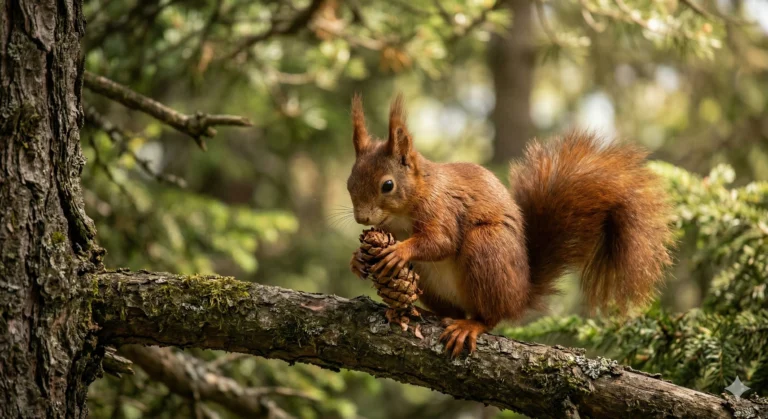
These nimble acrobats are a real treat for the eyes, especially if you're on a family outing with kids. In this article, we'll tell you where you're most likely to see them around Bansko, what their habits are and why it is critically important to follow certain rules when communicating with them.
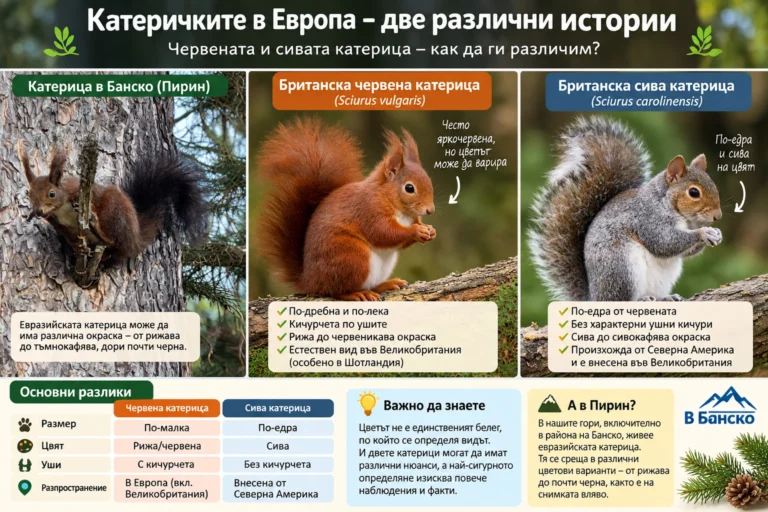
The species that inhabits the forests of Pirin is the European red squirrel. Despite its name, its fur color can vary significantly depending on the season – from bright reddish-brown in summer to a darker, gray-brown or even almost black shade in winter. They are characterized by tassels on the ears, which become especially pronounced during the cold months, and a large, bushy tail, which serves for balance and warmth.
Where around Bansko can we meet squirrels?
Squirrels are forest dwellers and prefer coniferous or mixed forests, where there is an abundance of cones, acorns and seeds. The area above Bansko is ideal for their observation, as it offers extensive areas of white and black pine, fir and spruce. Here are the best locations for "hunting" squirrel footage:
- The ski road to Bansko: In summer and autumn, the ski trail becomes a wonderful eco-trail. The forest on both sides is teeming with life, and squirrels often cross the path or chase each other along the tree trunks.
- The area around the Baykushevata mura and Banderitsa hut: The ancient forests in this area are a natural home to many wild animals. While enjoying the oldest tree in Bulgaria, look around the branches – you are almost certain to spot a fluffy tail.
- The path to Demyanitsa hut: This route passes through dense and cool forests along the Demyanitsa River. The silence and less human presence (compared to the road to Vihren) make the squirrels braver.
- The Rolbana area and the paths above the city park: You don't even have to climb high into the mountains. Already in the first kilometers above Bansko, in the mixed forests, you can hear their characteristic "clicking" and rustling in the dry leaves.
Rules for responsible behavior in the wild
Although squirrels often seem tame and curious, approaching people in the hope of a treat, we are guests in their home. As responsible tourists, we must follow strict rules.
It is strictly forbidden to offer squirrels (and other wild animals) bread, pretzels, cookies, chips or chocolate! These processed foods are highly toxic to their digestive system, can cause serious illness and even death. In addition, systematic feeding makes them dependent on humans and dulls their natural instincts to search for food and protect themselves from predators.
What should we do if we still want to treat them?
The best solution is to let wild animals eat what nature offers them. If you still want to leave something for them on a stump (without feeding them from your hand, as they can bite and carry diseases), use only raw, unsalted nuts in shells – walnuts, hazelnuts or sunflower seeds (unroasted).
The Invisible Gardeners of Pirin Mountain
Did you know that squirrels in Pirin play an extremely important ecological role? They are some of the best “gardeners” in the forest. In the fall, they collect thousands of seeds, nuts and cones, which they carefully bury in the ground as reserves for the harsh winter. Since their memory is not perfect, they often forget where they have hidden most of their provisions.
It is these forgotten seeds that germinate in the spring and give rise to new trees. In this way, the small, agile animals help in the natural renewal of the centuries-old Pirin forests, spreading the seeds far from the mother trees.
Tips for photographing squirrels
Capturing the perfect shot of a squirrel in the wild is a real challenge. They move erratically and very quickly. Here are some tips for amateur photographers:
- Arm yourself with patience: Find a spot in the forest with plenty of pine cones on the ground and just sit quietly. If you don't make any noise, the animals will soon get used to your presence.
- Use a telephoto lens: A lens with a focal length of 200mm or 300mm is the minimum requirement to photograph them up close without scaring them.
- No sudden movements: Squirrels react quickly to movement. Move your camera slowly and smoothly.
- Listen: Very often you will hear them first (rustling bark, falling cone flakes, or a grating sound) before you see them.
A walk through the forest trails above Bansko is a wonderful way to escape the stress of the city and connect with nature. Watching squirrels in Pirin is a fun experience that reminds us how alive and perfect the mountain eco-world is. Let's keep it clean and wild!