
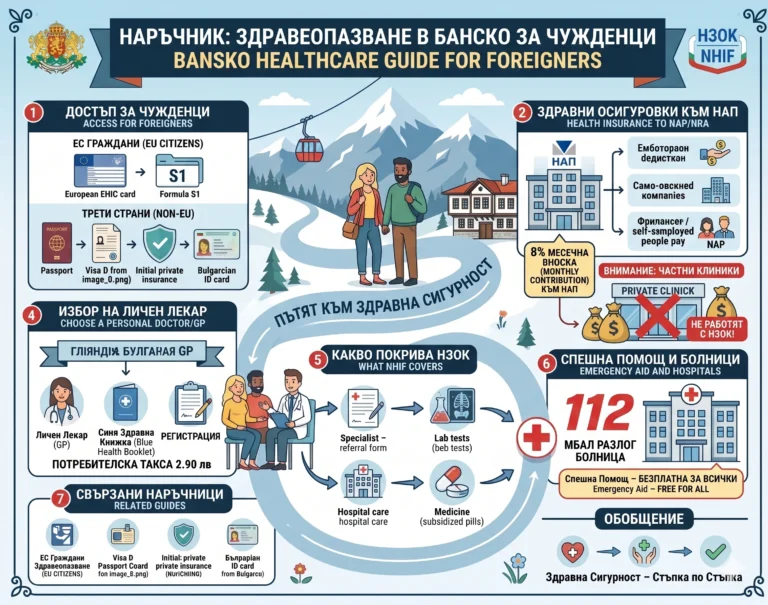
The foundation of public health is National Health Insurance Fund (NHIF). This is the state institution that manages the funds and covers the costs of treatment, examinations and medications. This detailed guide will guide you through everything you need to know about the NHIF in Bansko in 2026 – from initial registration to finding an English-speaking GP.
Why is registration with the NHIF mandatory?
Although Bansko has excellent private clinics, they are mainly intended for short-term tourists. In case of a serious health problem, chronic illness or need for hospitalization, the costs in the private sector can be prohibitive. The National Health Insurance Fund provides a “safety net” that guarantees your treatment at preferential prices or completely free of charge.
1. How does the NHIF system work in Bansko for foreigners?
Access to the system is not automatic. It depends on your legal status in Bulgaria and your citizenship. In 2026, the procedures are digitalized, but require correctly submitted documents.
Citizens of the European Union (EU)
If you are an EU citizen, you have the easiest access. For short-term stays of up to 90 days, your European Health Insurance Card (EHIC) is completely sufficient for emergency care. However, if you plan to live in Bansko long-term, you should transfer your insurance rights.
- Form S1: If you are a pensioner or work remotely for a company in the EU, you must submit an S1 form to the RHIF (Regional Health Insurance Fund).
- Employment contract: If you start working at a local company in Bansko, you become part of the system automatically with your first salary.
Third-country nationals (non-EU)
For citizens of the UK, USA, Israel and other non-EU countries, the process is two-step. Initially, for your Visa D, it is mandatory to have private medical insurance. Only after you receive your ID card (residence permit – permanent residence or permanent resident) and personal identification number (PIN/LNF), you can start paying contributions to the NHIF.
| Status | Access to NHIF | Required document |
|---|---|---|
| Tourist (EU) | Emergency only | EHIC |
| Resident (EU) | Full | ID card + Form S1 |
| Resident (non-EU) | Full after LNF | Residence permit |
2. Health insurance and payment to the National Revenue Agency
It is important to understand that NHIF in Bansko only provides the services, but the money is collected from National Revenue Agency (NRA). Without paid insurance for the last 60 months (or the corresponding period since entering the system), your "health insurance rights" are interrupted.
If you are a digital nomad and self-insured, the contribution is calculated as a percentage of the minimum social security income. You can pay your social security contributions online through the NRA portal with a PIN code or by bank transfer at the bank branches in the center of Bansko.
3. Choosing a Personal Doctor (GP) in Bansko
The heart of the system is you General practitioner (GP). In Bansko, most GPs are located in the building of The medical center (Polyclinic), located near the city center.
Registration steps:
- Choosing a doctor: Ask in local expat groups for a doctor who speaks English or your language.
- Registration form: An initial selection form is filled out. You can purchase it from a bookstore or get it on site.
- Blue health card: After registration, you will be issued a health insurance card. It is mandatory when visiting a dentist or specialist.
Remember that you can only change your GP during the months June and December every year.
4. What does NHIF cover? (Services and fees)
The system in Bulgaria operates through so-called “Referrals.” If you need a cardiologist or an ultrasound, your GP issues you a referral, which makes the examination almost free.
- User fee: A symbolic fee of 2.90 BGN (about €1.50) is paid for each examination.
- Specialists: Examinations by specialized specialists with referral.
- Laboratory: Most standard blood and urine tests are covered.
- Dentist: The NHIF covers a small portion of dental services (usually one examination and two fillings per year with a co-payment).
5. Razlog Hospital and Emergency Room
One of the most important facts for those living in Bansko is that the city there is no large general hospital. When in need of hospitalization, surgery or emergency room, Bansko residents use Razlog Hospital.
The hospital in Razlog is only 6 km away (about a 10-minute drive). It is well-equipped and has specialists in internal medicine, a pediatric department, and traumatology – something critical for a ski resort.
🆘 Emergencies (Phone 112)
In the event of an accident on the road or at home, dial 112. Ambulances and emergency services in public hospitals are free for absolutely everyone, regardless of social security status. This is a humanitarian right in Bulgaria.
6. Pharmacies and medicines in Bansko
In Bansko there are many pharmacies, but not all of them work with the NHIF for subsidized medicines. If you are taking medication for chronic diseases (high blood pressure, diabetes), your GP will issue you electronic prescription. You need to find a pharmacy with an NHIF sticker to get your medications at a discount or for free.
Tip: In Bansko, pharmacies are rarely open 24/7 outside of the active ski season. Always keep a basic first aid kit at home.
Conclusion and tips for expats
Healthcare through NHIF in Bansko is an extremely economical option that offers security. Although you may encounter a language barrier in government institutions, the community in Bansko is very close-knit and you will always find someone to help you with translation.
Don't wait for an emergency to arise. Organize your documents, choose your personal doctor within the first month of your stay, and enjoy the tranquility that Pirin Mountain offers.