


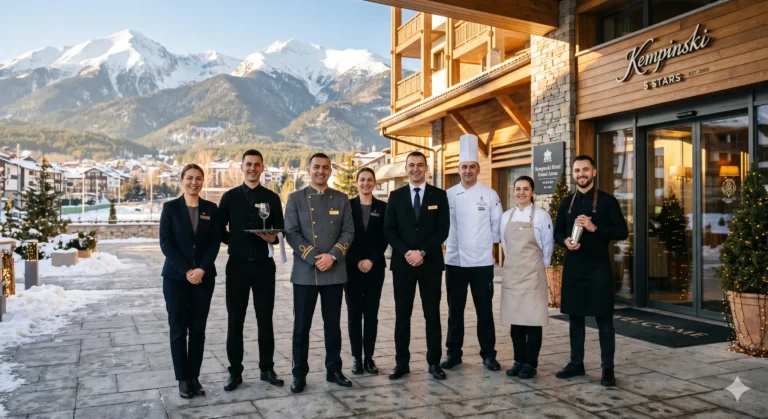
How can you avoid this vicious practice and guarantee a stable, loyal and motivated team throughout the winter (or summer) season? Managing human resources in a resort town requires a fundamentally different approach than in the capital or big cities. Here are the most effective strategies that have been proven to work at the local level.
1. Accommodation: The hidden trump card in attracting staff in Bansko
Many employers make the mistake of thinking that a high financial reward is enough. In Bansko, salary is far from everything. The biggest stumbling block for seasonal workers who arrive from within the country (or from other countries) is accommodation.
Rent prices in the city skyrocket in the winter, and beds fill up quickly. A seasonal worker can easily spend half their salary just on a bed in a shared room and heating.
- The strategy: If you provide free or heavily subsidized housing for your team, you automatically gain a huge competitive advantage over those businesses that only offer pure compensation.
- The solution in practice: Successful businesses often rent long-term (year-round) cheap apartments or guest houses in the more remote neighborhoods of Bansko or even in the neighboring town. Razlog, where rents are lower. Others are converting unused premises into their own properties. This is not just an expense – it is a strategic investment that guarantees security and loyalty.
HR Tip: Food as a Social Bonus
In addition to accommodation, providing a hot meal during a shift (the so-called “personnel meal”) is an absolute standard in the hospitality industry. A worker who doesn’t think about how he’s going to pay his rent and what he’s going to eat today is fully focused on his job.
2. Where to look for people: Beyond the municipality
Relying entirely on local staff from Bansko, Banya and Dobrinishte simply doesn't work anymore. The majority of the local working population either runs their own family businesses (guest houses, ski lockers, transport services) or is already permanently employed in established large complexes with year-round employment.
Student brigades and internships
Proactively contact universities of tourism, food technology and language high schools in Plovdiv, Blagoevgrad and Sofia. Students are massively looking for internship opportunities and good income during their winter vacation. They are young, energetic, often speak foreign languages and easily learn new skills, despite the lack of many years of experience.
Import of personnel from third countries (Third-country nationals)
This is not just an alternative, but the new reality in Bulgarian tourism. Many of the largest hotels and chains in Bansko are already operating thanks to staff from Ukraine, Moldova, Kyrgyzstan, Nepal, Turkey and the Philippines.
- The procedure: Keep in mind that the process requires serious technological time. Preparing documents for work visas and residence permits takes at least 3 to 4 months. You can't remember in November that you need cooks from Nepal for December. The best option is to use specialized HR agencies that handle all the bureaucracy with the Migration Directorate and the Employment Agency.
- The huge advantage: These workers arrive with a strictly defined contract for the entire season. Their visa is tied to you as the employer. This means that they will not spontaneously leave on January 1st because they had a fight with the manager or because the tavern next door offered them 50 leva more. They bring stability.
3. Seasonal contracts, insurance and Labor Inspection
Working in the “grey sector” in Bansko is becoming increasingly risky. The Labor Inspectorate, together with the National Revenue Agency, conducts massive inspections throughout the winter season, often accompanied by the Economic Police. Fines for a worker without an employment contract start at several thousand leva – an amount that renders any “savings” on social security contributions meaningless.
The law actually provides quite flexible options, adapted to the needs of tourism, that allow you to be completely compliant:
- One-day employment contract (Art. 114a of the Labor Code): An extremely convenient tool for hiring "extra" staff during peak weekends, New Year's or the student holiday (December 8). The contract is registered online in the NRA system literally in minutes, and the remuneration is paid immediately at the end of the shift against a receipt.
- Fixed-term employment contract for the season (Art. 68 of the Labor Code): This is the classic option. It is important to consult with a lawyer or accountant about the notice clause. Make sure it is clearly written so that you are not left without a key figure “from one day to the next”.
Attention: Respect the breaks!
The most common acts from the Labor Inspectorate in resorts are not for lack of a contract, but for failure to observe the daily and weekly rest. No matter how busy, overworked staff makes mistakes, leads to accidents in the kitchen and serves customers poorly. Provide a schedule that allows for real recovery.
4. Employee Retention: How to keep them from running away?
The biggest nightmare of any entrepreneur in Bansko is for the head chef or experienced bartender to throw in the apron in February (the busiest month for British vacations) because the hotel next door has offered him a little more money. How to build loyalty?
- End of Season Bonus: This is one of the most effective practices. Include in the employment contract an official bonus (for example, half or one additional salary) that is paid only and only if the employee stays on the job until the official end of the season (e.g. March 31). This financially motivates people to endure the pressure to the end.
- Fair Tips (Service Charge): Implement a clear, transparent, and fair tip distribution system. If you create a rule that a percentage of waiters“ tips go to the kitchen and bartenders, you will dramatically reduce tension between the ”front“ and ”back” teams. When everyone benefits from a full establishment, teamwork flourishes.
- Culture of respect: It sounds trite, but in the stressful and tense environment of the winter season, scandals are a daily occurrence. An owner or manager who yells at his staff in front of customers will inevitably lose his people. Be a leader, resolve conflicts in the office, not in the salon, and have your employees' backs in the face of unfriendly customers.
5. Training: Don't count on finding "ready-made" staff
Many businesses waste valuable time searching for “the perfect waiter with 10 years of experience and three languages,” which is simply lacking in today’s job market. The modern approach is different: hire for attitude, train for skills.
Set aside at least two weeks in November – before the big rush – for intensive internal training. Get the whole team together. Do a tasting of the entire menu so the waiters know what they’re selling. Role-play with problem customers. Conduct basic English training on the most important phrases for the restaurant or hotel. This initial investment of time and energy will pay off tenfold in the form of higher bills, fewer returned orders, and thousands of satisfied tourists.
Next step: Technical support and craftsmen
You have a trained team, a full establishment with customers and proper documents. But suddenly the boiler explodes and the heating stops on New Year's Eve. The last critical piece of the local business puzzle remains – technical support. How do you find reliable craftsmen and subcontractors in a region where everyone is busy, and how do you protect yourself from fraud?